



Ironmartonline Reviews: Complete Guide to Evaluating the Heavy Equipment Marketplace in 2026
Buying a used excavator, loader, truck, or forestry machine online can involve tens of thousands of dollars. That makes seller history, equipment documentation, and transaction structure more important than a polished website.
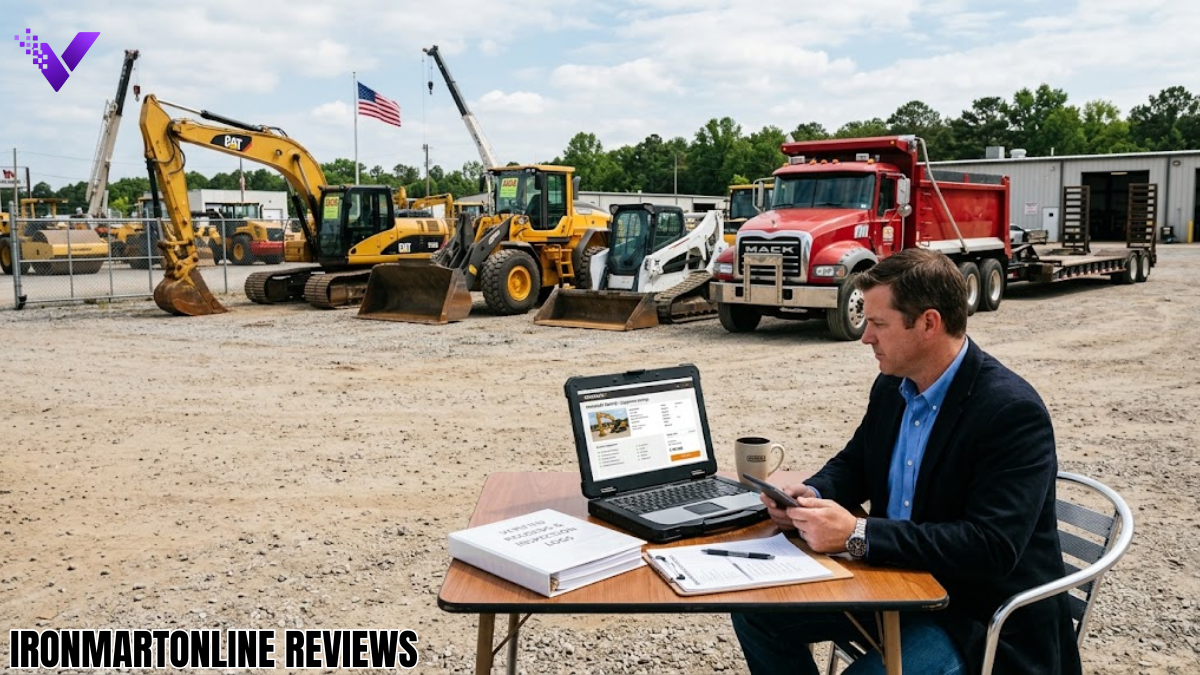
Current ironmartonline reviews and public business signals lean generally positive. IronMartOnline operates as a specialized heavy-equipment marketplace and brokerage, with an active catalog covering construction machines, trucks, attachments, forestry equipment, paving machinery, and other commercial assets.
The strongest evidence is practical rather than promotional. At the time of review in September 2026, the site’s Heavy Equipment section showed 413 products, including machinery from Caterpillar, Komatsu, John Deere, Bobcat, Case, JCB, and other manufacturers.
What Are Ironmartonline Reviews?
Ironmartonline reviews are customer feedback, third-party reputation signals, marketplace observations, and transaction-related assessments used to judge IronMartOnline as a place to buy or sell used commercial machinery.
The company operates closer to a broker-assisted marketplace than a conventional ecommerce store. Its own material says equipment sellers receive exposure through multiple marketing channels while buyers can browse detailed machinery listings and contact the business about individual assets.
Quick Review Flow
Find a machine → Confirm availability → Examine specifications → Verify equipment identity → Arrange inspection → Confirm transaction terms → Complete purchase
For sellers:
Submit equipment → Establish asking terms → Build listing → Market the asset → Handle buyer inquiries → Negotiate → Close the sale
The distinction matters. A heavy-equipment marketplace helps create the deal, but the website itself should never substitute for mechanical and legal due diligence.
Why Is IronMartOnline Important?
People researching ironmartonline reviews are normally dealing with much higher financial exposure than an ordinary online shopper.
Its specialized model offers several useful characteristics:
- Niche inventory: visitors are searching specifically for machinery, trucks, trailers, and related equipment.
- Large equipment range: the live catalog spans excavators, loaders, dozers, paving machines, forklifts, forestry equipment, attachments, and specialty assets.
- Visible pricing: many current listings show an asking price rather than forcing visitors to request basic pricing information.
- Detailed specifications: listings commonly identify hours, horsepower, attachments, operating configuration, weight, and condition.
- Long public footprint: an IronMartOnline eBay account has been active since December 27, 2004.
- Broker support: the business markets itself around connecting equipment owners with prospective buyers rather than simply providing classified-ad space.
- Seller exposure: IronMartOnline says it distributes machinery across nine marketing platforms and channels. That is a company claim rather than an independently audited reach figure.
The overall model can therefore be useful for both asset discovery and equipment liquidation, provided each individual transaction is checked on its own merits.
Quick Reference Matrix
| Core Element | Action / What It Involves | Primary Goal / Output |
| Marketplace model | Connects machinery buyers with equipment offered for sale | Create qualified transactions |
| Current inventory | Hundreds of equipment listings across specialist categories | Broader machine selection |
| Listing data | Displays specifications, hours, configuration, condition, and prices | Faster initial screening |
| Public reputation | Review sites and external marketplace activity provide outside signals | Establish business history |
| Seller marketing | Equipment promoted beyond a single product page | Increase buyer exposure |
| Broker contact | Prospects discuss equipment before closing | Support negotiation |
| Financing access | Site links buyers to business financing options | Expand purchase flexibility |
One outside review directory, Trustburn, currently displays a 4.0/5 average from nine reviews. That is encouraging, but nine reviews remain too small a sample to treat as definitive proof of transaction quality.
How to Evaluate IronMartOnline Before Buying
A generally favorable reputation reduces uncertainty. It does not eliminate the need to evaluate the specific machine being purchased.
Step 1: Confirm That the Listing Is Still Active
Start with the exact manufacturer, model, year, asking price, and equipment location.
Ask the broker to confirm availability before arranging financing or transport. Inventory in commercial machinery moves differently from ordinary ecommerce stock, and a listing may attract inquiries from multiple buyers.
Record:
- Listing URL
- Stock or reference information
- Current asking price
- Equipment location
- Contact person’s name
- Date availability was confirmed
This gives both sides a clear reference if the conversation continues for several days.
Step 2: Match the Machine to Its Identification Records
Photos are useful. Serial numbers are stronger evidence.
Request the complete machine identification number, VIN, or manufacturer serial number where applicable. Compare it with the identification plate visible on the machine and with any ownership paperwork supplied by the seller.
For engine-powered commercial equipment, also ask whether the machine’s engine serial, emissions configuration, or attachment serial numbers can be documented.
Step 3: Commission an Independent Mechanical Inspection
Never evaluate a five- or six-figure machine from listing photographs alone.
Hire an inspector who is independent of the seller and broker. The inspection scope should fit the equipment type.
For a tracked excavator, for example:
- Measure undercarriage wear.
- Check boom and stick pins.
- Inspect hydraulic cylinders.
- Test swing bearing movement.
- Look for structural welding.
- Check fluid condition.
- Operate every hydraulic function.
- Run the machine under working temperature.
- Verify meter readings where technically possible.
A 500–1,500 professional inspection can be insignificant compared with an unexpected hydraulic pump, engine, transmission, or undercarriage repair.
Step 4: Establish Legal Ownership
Mechanical condition and legal ownership are separate risks.
The person offering the machine should be able to explain who owns it, who has authority to sell it, and what document transfers ownership.
Depending on the machine and jurisdiction, review:
- Bill of sale
- Title, where applicable
- Seller identity
- Business entity details
- Existing finance interests
- UCC filings
- Lien releases
- Previous ownership records
Commercial equipment may not follow the same title system as passenger vehicles, so the correct documentation can differ by asset type and state.
Step 5: Lock Down Payment Instructions
Wire fraud is a separate threat from marketplace legitimacy.
Get payment information through the known contact channel. If banking details change shortly before settlement, verify the change by phone using a previously confirmed number, not a number contained only in the new email.
The final invoice should clearly identify:
- Purchaser
- Seller
- Equipment
- Serial or VIN
- Sale price
- Deposits
- Remaining balance
- Tax treatment
- Pickup or delivery responsibility
Never send a high-value transfer because someone creates artificial urgency.
Step 6: Calculate the Landed Cost
The listing price is not necessarily the amount needed to put the machine to work.
Calculate:
Purchase Price + Inspection + Tax + Loading + Transport + Permits + Insurance + Immediate Repairs = Landed Cost
A $45,000 loader located several states away can become substantially more expensive once oversize transport, permits, tires, fluid service, and repairs enter the equation.
Compare machines using landed cost rather than sticker price.
Step 7: Preserve the Transaction File
Keep one digital folder for the complete deal.
Save the:
- Original advertisement
- Photos
- Videos
- Inspection report
- Invoice
- Payment receipt
- Bill of sale
- Serial-number photograph
- Transportation documents
- Written representations
High-value machinery can change ownership again years later. Good records strengthen resale documentation and accounting support.
Industry and Use-Case Specific Scenarios
IronMartOnline for Construction Contractors
Contractors frequently need a replacement machine without waiting for a factory order.
The marketplace can be particularly useful when the requirement is highly specific: for example, a mid-size excavator with auxiliary hydraulics, a hydraulic thumb, enclosed cab, and particular weight range.
Current listings demonstrate that specifications can be detailed enough to eliminate obviously unsuitable machines before a phone call.
IronMartOnline for Fleet Owners Selling Surplus Assets
A contractor retiring several machines faces a different problem: finding commercial buyers rather than casual local inquiries.
IronMartOnline states that it markets seller equipment through channels including its own site, email, marketplace platforms, Google Business, Craigslist, YouTube, and other outlets. Sellers should request the exact marketing package and commission terms in writing rather than assuming every channel applies to every listing.
IronMartOnline for Forestry Operations
Forestry equipment has a smaller buyer pool than mainstream pickup trucks or passenger vehicles.
The site currently carries categories specifically covering feller bunchers, wood chippers, log skidders, tree equipment, and material-handling machinery. That specialization may reduce the amount of irrelevant searching required by operators working in logging and arborist businesses.
IronMartOnline for Remote Buyers
A machine located 800 miles away changes the economics of a purchase.
Remote buyers gain more value from third-party video, local inspections, carrier quotations, fluid analysis, and precise loading information than from repeatedly asking whether a machine “runs well.”
Distance makes documentation valuable.
Broker-Assisted Marketplace vs. Equipment Auction
| Factor | Broker-Assisted Purchase | Equipment Auction |
| Sale mechanism | Private negotiation | Competitive bidding |
| Price movement | Buyer can make an offer | Other bidders influence final price |
| Decision window | Often negotiable | Fixed closing time |
| Inspection timing | Can usually be arranged before agreement | Often limited to scheduled preview periods |
| Buyer pressure | Generally lower | Countdown can accelerate decisions |
| Machine sourcing | Broker can discuss a specific requirement | Buyer searches available auction inventory |
| Negotiation style | Direct commercial discussion | Bid increments |
| Unsold equipment | Seller may revise terms | Depends on reserve structure |
Neither format automatically produces the lower final cost. Asset condition, seller motivation, transport distance, market demand, and buyer preparation can matter more than the selling channel.
Common Mistakes & Best Practices
Common Mistakes to Avoid
- Treating a rating as a warranty. A company’s overall reputation says nothing certain about the hydraulic system inside one particular excavator.
- Misreading unrelated marketplace feedback. The IronMartOnline eBay profile currently shows 100% positive feedback and 284 positive-feedback points, but visible recent entries include feedback about IronMartOnline acting as a buyer. That history supports account longevity; it should not be interpreted as 284 verified heavy-equipment sales.
- Buying from photographs alone. Paint can look excellent while expensive drivetrain or hydraulic wear remains invisible.
- Accepting an hour meter without context. Meter replacement, idle hours, utilization history, and maintenance quality can change what the number means.
- Ignoring attachment value. Buckets, quick couplers, thumbs, forks, blades, auxiliary hydraulics, and specialty heads can materially change a machine’s usable value.
- Wiring money after an email-only banking change. Business-email compromise can target legitimate transactions.
- Booking freight before measuring the machine. Width, height, weight, detachable attachments, and loading capability affect trailer selection and permit costs.
How to Maximize Efficiency / Best Practices
- Ask for a cold-start video showing the machine before the engine reaches operating temperature.
- Request close photographs of wear points rather than exterior paint.
- Obtain an oil or coolant analysis when engine condition could materially affect the deal.
- Compare the machine against three similar listings with comparable year, hours, configuration, and geography.
- Ask whether significant components were rebuilt, replaced, or resealed.
- Confirm exactly which attachments and loose components are included.
- Get a freight quote before making a final offer.
- Put verbal representations that influenced the purchase into the written transaction record.
- Budget a post-purchase service reserve even when the machine appears ready for work.
Those habits improve purchasing quality on almost any used-equipment marketplace.
Future of Online Heavy-Equipment Buying
Used machinery sales are becoming more data-driven.
Telematics records can increasingly provide utilization history beyond a dashboard hour meter. Buyers may be able to examine idle time, fault codes, fuel consumption, location history, and operating patterns when owners retain accessible machine data.
Remote inspections are improving too. High-resolution video, live video calls, drone footage, thermal imaging, electronic control-module reports, and laboratory fluid testing can make cross-state and international purchasing more practical.
Digital maintenance records should become another differentiator. A machine supported by timestamped dealer invoices and service history is easier to evaluate than one described simply as “well maintained.”
Payment verification is also likely to receive more attention. Better business-identity validation, secure document signing, verified bank details, and transaction-specific fraud controls would reduce one of the largest risks surrounding remote high-value sales.
Pricing technology will change equipment discovery as well. Large datasets can compare machine age, operating hours, geography, configuration, manufacturer, auction results, and historical asking prices much faster than manual research.
Human judgment still matters. A pricing algorithm cannot hear a failing final drive during operation.
Practical Buyer and Seller Checklist
Before considering a transaction ready to close, confirm:
- The legal names on the invoice match the parties actually conducting the sale.
- Sales tax responsibility has been established.
- The quote has a defined validity period.
- Every attachment included in the purchase is individually identified.
- Loading assistance has been discussed with the equipment location.
- The carrier has suitable cargo insurance.
- The expected pickup window is written down.
- Storage charges after the agreed pickup date are understood.
- Any deposit conditions are documented.
- Export buyers know the destination country’s emissions and import requirements.
- Seller and buyer each retain the final signed transaction documents.
- No unresolved verbal promise remains outside the paperwork.
A checklist like this catches commercial problems that a mechanical inspection will never identify.
Final Thoughts
Current ironmartonline reviews and external signals present a generally positive picture of an established niche marketplace. The site carries substantial current inventory, an associated eBay account has existed since 2004, and Trustburn presently shows a positive 4.0/5 rating, although its sample consists of only nine reviews.
A separate website-risk service also characterizes the domain as very likely legitimate, citing factors including its age and valid SSL certificate, while simultaneously noting that reviews on major review sites are limited. Automated trust services are useful supporting evidence, not a substitute for transaction-level verification.
The practical verdict is straightforward: IronMartOnline appears to be a legitimate, active heavy-equipment marketplace worth considering, particularly for specialized used machinery. Treat the platform as the beginning of due diligence, not the end of it.
Frequently Asked Questions – FAQs
Is IronMartOnline a legitimate website?
Public evidence supports the existence of an active, long-running equipment business. Its current website carries hundreds of machinery listings, and the associated eBay account dates to December 2004.
Legitimacy of the platform does not automatically establish the condition or ownership status of every machine offered through it.
Are ironmartonline reviews mostly positive?
The accessible feedback currently leans positive. Trustburn displays 4.0/5 from nine reviews, while the company’s eBay profile shows a long history and positive account feedback.
The independent sample is still relatively small, so buyers should give greater weight to machine-specific evidence and transaction documents.
Does IronMartOnline own the equipment it advertises?
IronMartOnline describes itself as a heavy-equipment sales, marketing, and brokerage operation connecting equipment sellers with buyers.
Ownership can therefore depend on the individual listing. Buyers should identify the legal owner before purchasing.
Does IronMartOnline provide financing?
The current website displays a business financing option linked from its marketplace pages.
Approval, rates, down-payment requirements, collateral rules, and financing terms depend on the finance provider and applicant rather than the equipment listing alone.
Does used machinery from IronMartOnline include a warranty?
Never assume a used commercial machine carries a warranty unless the specific sale agreement explicitly provides one.
Many used-equipment transactions are structured around existing condition, so warranty coverage, return rights, and representations should be confirmed before payment.
Can buyers negotiate the advertised price?
Broker-style sales commonly allow commercial discussion between the interested buyer and seller.
Whether a seller accepts a lower offer depends on market demand, machine condition, time on market, ownership circumstances, and the seller’s minimum acceptable figure.
Can international buyers use IronMartOnline?
IronMartOnline describes its marketing reach as both domestic and international.
Overseas buyers should separately price ocean freight, inland hauling, port handling, customs duties, emissions compliance, insurance, and destination-country import rules before committing.