






INS Meaning: Complete Guide to Understanding the Acronym in Every Context
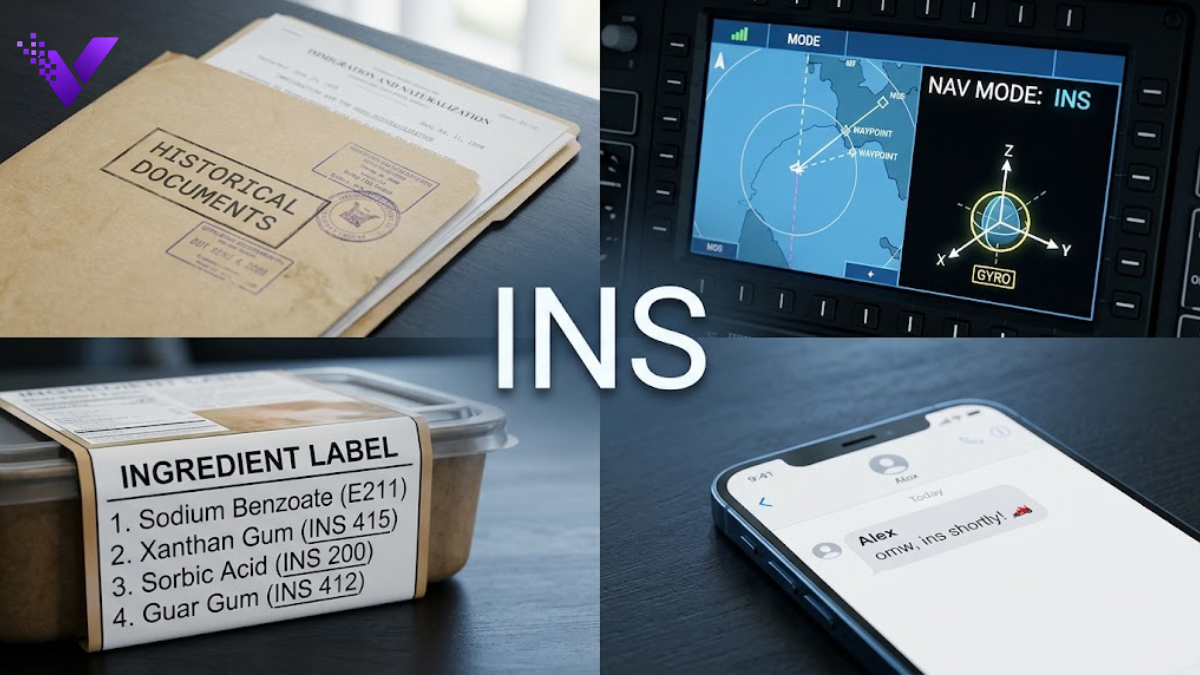
Three letters can point to completely different subjects. INS may describe a former U.S. immigration agency, an aircraft navigation system, a food-additive numbering framework, or an informal abbreviation used online.
The INS meaning depends on context, capitalization, surrounding words, location, and date. A reference in an old immigration file has little connection with the same letters inside an aviation manual.
This guide is built for readers who want to identify the correct definition quickly without mixing unrelated uses.
What Is INS Meaning?
INS is an acronym or abbreviation with several recognized expansions rather than one universal definition. The most established interpretations include Immigration and Naturalization Service, Inertial Navigation System, and International Numbering System for Food Additives. Dictionaries also record shorter forms connected with words such as insurance or inches, while some internet-slang references assign informal meanings.
The correct INS meaning therefore comes from the material surrounding the abbreviation.
Quick identification flow:
Find “INS” → Read surrounding words → Identify the subject → Check date or document type → Match the full form → Verify against an authoritative source
A sentence about accelerometers and aircraft position, for example, points toward navigation. A document discussing U.S. immigration before 2003 points toward the former federal agency.
Why Is INS Meaning Important?
Getting the acronym right prevents several practical problems:
- Legal accuracy: Old U.S. immigration documents frequently refer to an agency that no longer operates under that name.
- Technical accuracy: Aviation and engineering documents use INS for a specific form of self-contained navigation.
- Food-label interpretation: An INS number can identify a food additive under the Codex system.
- Historical clarity: Archived reports may use organizational names that have since disappeared.
- Translation quality: Expanding the abbreviation before translating prevents a completely unrelated interpretation.
- Search precision: Adding a field such as aviation, immigration, or food produces far more relevant results.
- Editorial consistency: Writers can define the acronym once and use the shortened form cleanly afterward.
Quick Reference Matrix
| Core Element | Action / What It Involves | Primary Goal / Output |
| Immigration | Read INS as Immigration and Naturalization Service in appropriate historical U.S. material | Correct agency reference |
| Navigation | Match INS with aircraft, spacecraft, drones, gyroscopes, or accelerometers | Technical interpretation |
| Food additives | Look for a number attached to INS | Additive identification |
| Online communication | Judge meaning from the conversation itself | Informal interpretation |
| Dictionary abbreviation | Examine punctuation and lowercase usage | Word expansion |
| Historical media | Check publication dates and organization names | Archive interpretation |
How to Identify the Correct INS Meaning Step by Step
Finding the intended definition is mainly an exercise in context analysis. The abbreviation itself rarely provides enough information.
Step 1: Check Capitalization and Punctuation
Start with the way the letters appear.
- INS usually signals an acronym or proper organizational/technical term.
- ins. can function as a conventional written abbreviation.
- ins inside casual messages may be shorthand rather than a formal initialism.
- A number immediately following the letters can indicate a classification system.
Collins, for example, records uses associated with International News Service and abbreviated forms including inches and insurance.
Step 2: Read the Nearby Vocabulary
The surrounding nouns normally reveal the field.
| Nearby wording | Likely interpretation |
| Visa, naturalization, deportation, immigration file | Former U.S. immigration agency |
| Gyroscope, accelerometer, heading, velocity | Inertial navigation |
| Additive, ingredient, stabilizer, colour | Food numbering system |
| Newspaper, wire service, correspondent | International News Service |
| DM, profile, social platform | Informal internet shorthand |
Acronyms should be interpreted as part of a sentence, not as isolated dictionary entries.
Step 3: Identify the Professional Domain
Technical material normally uses acronyms consistently within its own discipline.
For aviation, the Federal Aviation Administration defines an Inertial Navigation System as a form of self-contained RNAV navigation. NASA also uses INS for systems that provide aircraft data such as position, velocity, attitude, and acceleration.
That makes the surrounding professional field one of the strongest clues available.
Step 4: Check the Date
Dates matter most when dealing with American immigration records.
The Immigration and Naturalization Service was absorbed into the Department of Homeland Security structure on March 1, 2003. Its former responsibilities were distributed across organizations including U.S. Citizenship and Immigration Services (USCIS), Immigration and Customs Enforcement (ICE), and Customs and Border Protection (CBP).
A 1998 immigration document can therefore legitimately refer to INS. A modern reader should not assume that the same agency still exists today.
Step 5: Look for a Number
Food-related usage follows a noticeably different pattern.
The Codex International Numbering System for Food Additives assigns identification numbers to additives. Codex explains that these identifiers generally contain three or four digits, sometimes followed by letters, such as 150a and 150b.
A phrase such as “INS 235” is therefore structurally different from an agency or navigation reference.
Step 6: Verify Formal Uses Against Primary Sources
Use authoritative sources when the acronym affects a legal, engineering, regulatory, or scientific interpretation.
For example:
- USCIS, DHS, or DOJ for historical U.S. immigration material.
- FAA or NASA for aviation and navigation terminology.
- Codex Alimentarius / FAO-WHO for food-additive identifiers.
Informal acronym websites can help explain chat slang, but they should not override official terminology in professional documents.
INS in Different Industries and Real-World Scenarios
INS in U.S. Immigration Records
Older green-card, citizenship, asylum, border, and enforcement material may refer to the Immigration and Naturalization Service.
A frequent source of confusion is seeing the agency name in an old case and searching for a modern INS office. The historical organization no longer exists in that form; its functions moved into the post-2003 homeland-security structure.
INS in Aircraft, Drones, and Space Systems
Engineers encounter the letters in inertial navigation.
Such systems use measurements from devices including gyroscopes and accelerometers to estimate motion. FAA material describes INS as self-contained navigation, while NASA documentation explains how inertial information can be integrated with GPS estimates.
This technology appears in areas ranging from aviation to spacecraft and robotic platforms.
INS on Food Ingredient Information
Food scientists, manufacturers, regulators, and label researchers may encounter INS numbers.
Codex created the International Numbering System as a harmonized way to identify food additives without requiring their potentially lengthy specific names every time. An important distinction: being listed in the INS does not itself mean that Codex has approved an additive for every food use.
INS in Text Messages and Social Media
Online usage is less controlled.
Some slang dictionaries list “I’m Not Sure” as an interpretation, while other informal sources associate lowercase “ins” with social-media shorthand. These meanings are not standardized in the same way as government, aviation, or Codex terminology, so the individual conversation should carry more weight than an acronym database.
INS in Historical Journalism
Another documented expansion is International News Service.
This interpretation may appear in newspaper archives, media history, citations, or material dealing with older news organizations. Dictionary references preserve this meaning even though ordinary modern readers encounter it far less often.
Inertial Navigation System vs GPS
One useful comparison involves the technical interpretation of INS.
| Factor | INS | GPS |
| Navigation basis | Measures vehicle motion internally | Receives satellite signals |
| External signal dependence | Can operate self-contained | Requires usable satellite reception |
| Main sensor concept | Inertial measurement | Radio-based positioning |
| Error behaviour | Position error can accumulate over time | Provides external position fixes |
| Signal interference | Does not depend on GPS reception for basic inertial operation | Can be affected by unavailable or disrupted satellite signals |
| Combined use | Supplies continuous motion estimates | Can correct accumulated inertial error |
NASA describes integrated GPS/INS systems in which GPS information is used to update inertial estimates, showing why the technologies are often combined rather than treated as substitutes.
Common Mistakes and Best Practices
Common Mistakes to Avoid
- Treating INS as one universal acronym. The letters belong to unrelated disciplines.
- Calling INS a current U.S. immigration agency. That organizational structure ended in 2003.
- Confusing INS with an IMU. An inertial measurement unit supplies sensor measurements; a navigation system processes such information to estimate navigation states.
- Assuming an INS food number proves universal approval. Codex explicitly separates identification from authorization.
- Applying internet slang to formal documents. A chat interpretation has little value inside an aerospace manual.
- Ignoring punctuation. “INS,” “ins,” and “ins.” can carry different editorial functions.
- Searching only the acronym. Three letters alone create unnecessary ambiguity.
How to Maximize Accuracy and Efficiency
- Expand acronyms on first use when writing for general readers.
- Add a domain word to searches, such as “INS aviation” or “INS food additive.”
- Preserve the original terminology when quoting historical records.
- Maintain a small project glossary when reviewing acronym-heavy technical material.
- Check the issuing organization, not merely the document title.
- Use source hierarchy: regulator first, specialist reference second, slang database last.
- Keep capitalization identical to the source when accuracy matters.
Future and Modern Trends
Modern technology is making acronym interpretation more context-aware. Search engines, language models, document classifiers, and knowledge systems increasingly use surrounding entities and subject matter rather than matching three letters against one dictionary definition.
The navigation field is also moving toward deeper sensor fusion. NASA research describes GPS/INS integration, while a NASA project updated in 2026 discusses distributed inertial measurement configurations for space robotics and CubeSat applications.
Food terminology continues to evolve as well. Codex records show CXG 36-1989, the standard covering Class Names and the International Numbering System for Food Additives, as modified in 2026, with additional revision work active during the year.
The practical lesson is simple: the INS meaning should be tied to the source and date, especially when interpreting regulated or historical information.
Practical INS Interpretation Checklist
Before accepting an expansion, confirm:
- Capitalization matches the intended term.
- The surrounding sentence belongs to the expected industry or subject.
- The document’s publication date supports that terminology.
- Geographic references fit the proposed country or regulatory system.
- Numbers following INS have been checked against the appropriate classification database.
- Technical hardware references match the proposed engineering definition.
- Historical organization names have not been mistaken for current institutions.
- Informal slang has been treated as context-dependent, not universal.
- High-stakes information has been checked against a primary source.
Final Thoughts
There is no reliable way to translate INS correctly without looking beyond the letters. Immigration history, navigation engineering, food regulation, media archives, and internet conversations all use the same abbreviation differently.
The safest way to handle the INS meaning is to identify the domain first and expand the acronym second. For professional material, confirm that interpretation through the organization responsible for the terminology rather than relying on a generic acronym list.
Frequently Asked Questions – FAQs
What does INS mean in texting?
Some online slang references define INS as “I’m Not Sure.” That usage is informal and not universally recognized, so the surrounding conversation is the best indicator.
Does INS mean Instagram?
Lowercase “ins” can appear as informal shorthand associated with Instagram in some online communities, but it is not a universal English abbreviation for the platform. “IG” and “Insta” may also appear depending on the user and region.
Is INS still a U.S. immigration agency?
No. The former Immigration and Naturalization Service ceased operating within its old structure when its components moved to the Department of Homeland Security on March 1, 2003.
What does INS stand for in aviation?
It stands for Inertial Navigation System. The FAA describes it as a self-contained RNAV navigation system.
What is an INS number on food?
An INS number identifies a food additive under the Codex International Numbering System. The number is an identifier and should not automatically be interpreted as permission to use the additive in every product or jurisdiction.
Is INS the same as GPS?
No. INS derives navigation information from inertial sensing, while GPS obtains positioning information using satellite signals. Integrated systems can use information from both technologies to improve navigation estimates.
Why does INS have so many definitions?
Initialisms are created independently by different industries. When unrelated phrases begin with the same three letters, the acronym overlaps even though the underlying concepts have no connection.