


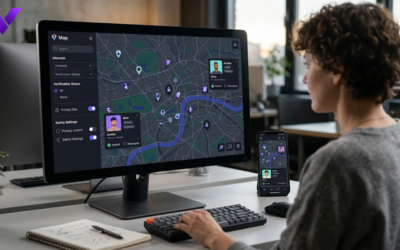

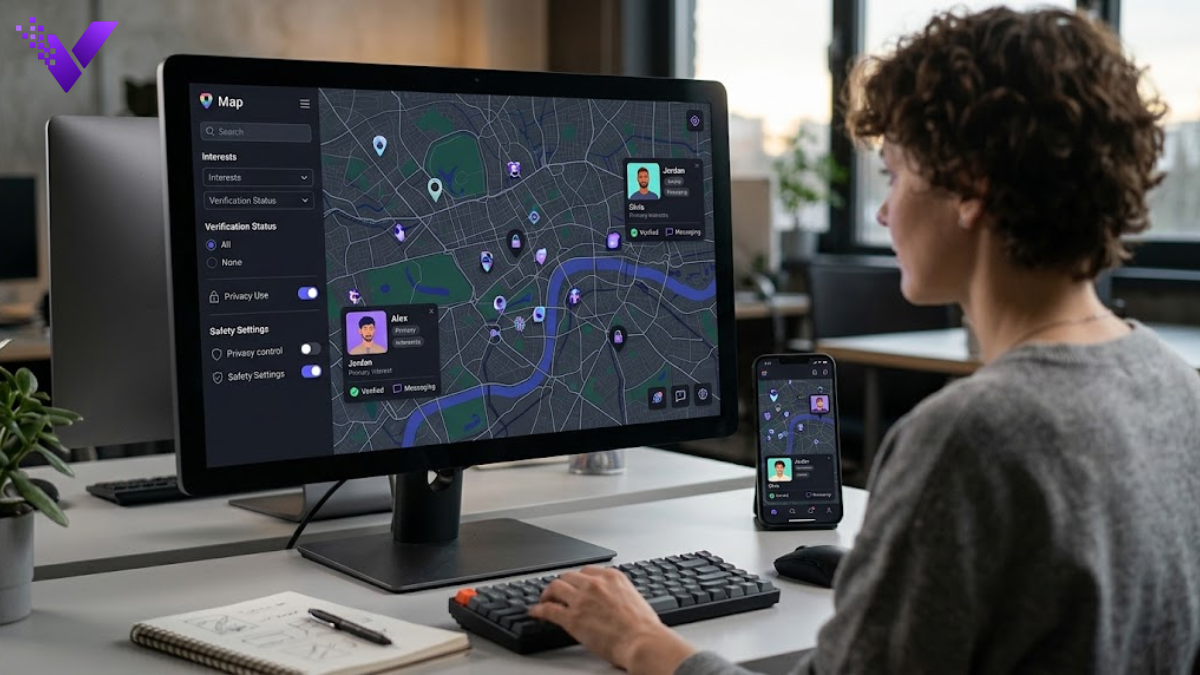
Sniffies Gay is built around a different discovery model from conventional dating platforms. Instead of leading with endless profile cards, the service places nearby activity on an interactive map and emphasizes proximity, current intent, and real-time connections.
That design makes the platform useful for adults who prefer location-aware social discovery over slower match-first systems. It also raises questions about privacy, visibility, account authenticity, and personal safety.
The platform is strictly 18+. Sniffies describes its product as a real-time interactive map for nearby users and cruising locations, while its community rules require adult participation, consent, respect, and lawful conduct.
What Is Sniffies Gay?
Sniffies Gay is a location-based social platform primarily associated with queer men seeking nearby connections. Its central interface is a digital map, allowing users to view activity geographically rather than discovering people through a traditional swipe queue.
The company’s current terms describe Sniffies as a geographic location-based social networking platform where people communicate through a digital mapping interface.
Basic flow:
Open platform → Confirm adult access → View local map → Review profiles/activity → Communicate → Decide whether to continue interaction
The map is designed for immediacy. That changes the experience from “find a profile first” to “see what is happening around a general location now.”
Why Is Sniffies Gay Important?
Sniffies Gay matters because it represents a distinct form of online social discovery rather than another variation of a swipe-based dating product.
Its main impact comes from several areas:
- Spatial context: Activity is organized geographically instead of primarily through ranked profile feeds.
- Faster discovery: Nearby availability becomes visible without working through a long sequence of matches.
- Intent clarity: The platform is positioned around spontaneous connections rather than requiring relationship-oriented framing.
- Queer-specific design: Its product language and community culture are built around LGBTQ+ social behavior rather than adapted from a general-market dating model.
- Large-scale usage: Match Group said in April 2026 that Sniffies had an estimated 3 million monthly active users and handled more than 20 million messages per day.
- Commercial significance: Match Group invested $100 million for a minority position in 2026, giving the category greater visibility within the mainstream online-connections industry.
Quick Reference Matrix
| Core Element | Action / What It Involves | Primary Goal / Output |
| Map interface | Displays activity geographically | Local discovery |
| User profile | Presents selected personal details | Context before contact |
| Messaging | Enables direct conversation | Establish compatibility |
| Location processing | Uses general geographic signals | Nearby relevance |
| Community controls | Reporting and blocking tools | User control |
| Platform policies | Define permitted behavior | Rule compliance |
| Adult restriction | Limits service to 18+ users | Adult-only access |
Step-by-Step Guide to Using the Platform Responsibly
1. Start From the Official Platform
Use Sniffies.com rather than assuming every similarly named mobile application belongs to Sniffies LLC.
This distinction matters. Current Google Play results include independently developed apps using similar naming while explicitly stating that they are not official Sniffies products.
- Check the domain before entering account information.
- Verify that policy pages identify Sniffies, LLC.
- Avoid entering credentials into third-party guides or unofficial clones.
- Bookmark the legitimate address if you use the service regularly.
This simple check reduces exposure to credential theft, misleading subscriptions, and impersonation apps.
2. Understand How Location Works
A map-based service can create the impression that it constantly reads a phone’s exact GPS coordinates. Sniffies’ privacy policy describes a different system.
Its May 2026 policy says the service does not access precise real-time GPS location from the device. Instead, it determines a general location from the user’s IP address, and an approximate position may become visible when map-based functionality is used.
That distinction affects expectations.
| Location Point | Practical Meaning |
| IP-derived area | Represents a general geographic position |
| Map visibility | Other users may see approximate presence |
| Device GPS | Current policy says precise GPS is not accessed |
| VPN or network changes | May affect IP-based geographic interpretation |
Never treat a map marker as a guaranteed physical coordinate.
3. Build a Profile With Deliberate Boundaries
A useful profile gives enough information for another adult to understand the person behind it without exposing unnecessary identifying details.
Consider information in three groups:
- Public: details you are comfortable showing broadly.
- Conversation-only: information shared after basic trust develops.
- Private: legal name, workplace, home address, financial details, account passwords, and other high-risk identifiers.
Avoid linking multiple pieces of information that make offline identification effortless.
For example, a unique employer + exact neighborhood + full-face image + public social handle can reveal far more than any single field alone.
4. Read Context Before Starting a Conversation
Map proximity tells you where general activity exists, not whether two users are compatible.
Check available profile context before writing. Look for obvious mismatches involving expectations, schedule, boundaries, or preferred type of interaction.
Keep the first exchange specific. A short message that responds to visible profile information is more useful than sending identical messages to dozens of accounts.
5. Verify What You Can
Sniffies states that it does not perform criminal background checks and does not guarantee the accuracy of information supplied by users.
Treat profiles as self-reported information, not verified identity records.
Before an offline meeting:
- Resolve major inconsistencies.
- Avoid sending money or financial credentials.
- Be cautious when someone pushes for immediate disclosure of personal information.
- Stop communication when behavior becomes threatening, coercive, or suspicious.
Digital familiarity is not identity verification.
6. Set Clear Boundaries Before Meeting
Good communication should answer practical questions before anyone changes location.
Discuss expectations, limits, timing, and consent clearly. Consent must remain voluntary throughout any interaction and can be withdrawn.
Sniffies’ community guidelines explicitly state that users should seek clear consent, respect boundaries, and avoid coercion or pressure.
Ambiguity is not agreement.
7. Use Platform Safety Controls When Necessary
Blocking and reporting tools are not only for extreme situations.
Use them for:
- Harassment
- Threats
- Repeated unwanted contact
- Suspected minors
- Impersonation
- Non-consensual content
- Doxxing
- Fraud attempts
- Unsafe or illegal activity
Sniffies says users can report problematic behavior and block other accounts. Its policies also prohibit harassment, stalking, intimidation, and sharing another person’s identifying information without consent.
Screenshots or timestamps may help when documenting serious misconduct, provided you handle another person’s private information responsibly.
Industry and Use-Case Specific Scenarios
Sniffies Gay for People Visiting a New City
Sniffies Gay can provide a fast picture of general activity in an unfamiliar area because the interface emphasizes geography.
Travelers still need to distinguish between platform visibility and local knowledge. A location appearing on a user-generated map does not automatically mean that activity there is lawful, permitted by a property owner, safe, or socially appropriate.
Check venue rules and local regulations separately.
Lower-Density Cities and Suburban Areas
Traditional profile feeds can feel empty when users are spread across large geographic zones.
A map interface can reveal whether activity is clustered around particular districts or travel corridors, giving geographic context that a simple distance number may not communicate as clearly.
Distance still matters. A visually nearby marker may involve a longer real-world journey because of road layouts, water, restricted access, or transit boundaries.
Privacy-Conscious Users
Privacy-sensitive users should think less about “being anonymous” and more about reducing linkability.
Linkability occurs when separate data points can be combined to identify one person. Reusing the same username, photograph, biography, email alias, or public social-media handle across multiple services makes that process easier.
A separate identity footprint can limit unnecessary cross-platform exposure.
High-Activity Events and Entertainment Districts
Local activity may change quickly around festivals, nightlife districts, conventions, holidays, and major community events.
Real-time discovery can therefore behave differently from a static dating directory. User density may rise sharply for several hours and disappear just as quickly afterward.
That makes timing a bigger variable than permanent population size.
Map-First Platforms vs Swipe-Based Dating
For readers evaluating Sniffies Gay, the largest structural distinction is not branding. It is the discovery architecture.
| Factor | Map-First Discovery | Swipe-Based Discovery |
| Starting point | Geographic activity | Individual profile |
| Browsing pattern | Spatial exploration | Sequential decisions |
| Time horizon | Often immediate | Often open-ended |
| Geographic awareness | Visually prominent | Usually secondary |
| Discovery density | Visible as clusters | Abstracted into feed |
| Decision style | Context-first | Profile-first |
| Serendipity | Place-driven | Algorithm/feed-driven |
| Planning behavior | Often short-term | Can support longer exchanges |
Neither format automatically produces better interactions. They optimize for different user behavior.
Common Mistakes & Best Practices
Common Mistakes to Avoid
- Assuming every user is verified
Account presence does not prove identity, background, age accuracy, employment, health claims, or personal history. - Installing lookalike software
Search results can contain independently produced products using similar keywords or branding. - Publishing identifiable routines
Exact work schedules, repeated gym times, vehicle details, building names, or daily routes can expose offline habits. - Treating user-generated place information as authorization
A location listed by community members does not override property rules or local law. - Sending money to unfamiliar users
Requests involving travel fees, emergencies, deposits, gift cards, cryptocurrency, or verification payments deserve immediate scrutiny. - Sharing another person’s material
Private messages, photographs, addresses, names, and sensitive information should not be redistributed without permission.
How to Maximize Efficiency / Best Practices
- Use a unique password that is not reused on email, banking, or social accounts.
- Control lock-screen notifications if message previews could reveal sensitive information.
- Audit old profile information instead of allowing stale details to remain indefinitely.
- Learn the reporting process before needing it, especially when traveling.
- Maintain current sexual-health knowledge through qualified local healthcare providers rather than relying on profile claims.
- Review privacy-policy changes periodically, since data practices can evolve.
- Separate platform conversations from financial activity; a social connection does not require access to payment accounts.
- Watch for pressure tactics designed to force fast decisions or secrecy.
Future and Modern Trends
The direction of Sniffies Gay is now tied to a larger industry shift toward real-time, intent-driven social discovery.
Match Group’s April 2026 investment gave Sniffies $100 million in strategic backing while leaving the company founder-led and independently operated. Match said the investment includes a possible path to acquiring the remaining equity later, but full ownership had not occurred in that announcement.
Trust and safety technology is also becoming more automated. Sniffies’ 2026 privacy policy says automated systems may be used for age estimation and content moderation, with machine-learning technologies helping identify certain potentially unlawful or harmful material.
Regulatory pressure will likely keep privacy controls, age assurance, content moderation, and transparency high on the product agenda across the wider adult social-platform sector.
Sniffies itself said the Match investment would support product improvements, network expansion, and additional Trust & Safety investment.
Practical Checklist
Before relying on the platform, confirm the following:
- I meet the 18+ requirement.
- I know which information can be seen by other users.
- My account password is not reused elsewhere.
- My notification previews match my privacy needs.
- I know the difference between approximate map location and exact GPS coordinates.
- I understand that user statements are not automatically verified.
- I can identify the official site rather than a third-party imitation.
- I know where the block and report controls are.
- I have reviewed rules relevant to my jurisdiction.
- I will not use the map interface while driving.
- I understand that the service is not an emergency-location system.
- I have checked the current privacy and community policies rather than relying on old screenshots or guides.
Final Thoughts
Sniffies succeeds by treating location and immediacy as primary interface elements rather than secondary filters. That makes the service fundamentally different from products built around swiping, matching, and long profile queues.
The strongest way to use any real-time social platform is to combine convenience with controlled disclosure, accurate expectations, consent, and independent judgment. Technology can show nearby activity. It cannot replace personal verification or decision-making.
Frequently Asked Questions – FAQs
Is Sniffies Gay only for gay men?
The platform is strongly associated with gay, bisexual, queer, and other men seeking connections with men. Match Group described Sniffies in 2026 as a platform serving GBTQ and non-heterosexual men, while Sniffies’ own community language emphasizes broad inclusion among adults who use its cruising platform.
Does Sniffies track your exact GPS location?
Its May 2026 privacy policy says the service does not access precise real-time GPS location from the device. It says general location is derived from the user’s IP address and can be displayed approximately through location-based features.
Is Sniffies anonymous?
Do not assume complete anonymity. Even when a service does not display a legal identity publicly, account activity, device information, network location, uploaded content, communications, and other data can still create an identifiable digital footprint.
Review the current privacy policy before sharing sensitive information.
Does Sniffies conduct background checks?
No. Its terms state that Sniffies does not conduct criminal background screenings and does not verify information supplied by users.
Users therefore need to make their own decisions about whether another person’s claims appear trustworthy.
Is Sniffies owned by Match Group?
Not fully, based on the announced April 2026 transaction. Match Group invested $100 million for a significant minority stake, while Sniffies remained independently operated and founder-led.
The agreement included an option that could allow Match Group to acquire the remaining equity in the future.
Is Sniffies available to people under 18?
No. Sniffies states that its platform is strictly restricted to adults aged 18 or older.
Suspected underage activity can be reported through the platform’s safety systems.
Is every app named Sniffies official?
No. Current app-store search results include third-party guides and similarly named products that explicitly state they are not affiliated with Sniffies LLC.
Verify the developer and destination before entering credentials or payment information.