



Research Dossier for Target Company: Complete Guide to Building a Decision-Ready Company Intelligence File
A research dossier for target company turns scattered corporate information into a structured intelligence file. Instead of collecting random search results, the researcher connects legal records, ownership, financial signals, leadership, products, market activity, digital assets, risks, and verified evidence.
That distinction matters in 2026. Public databases are richer, company structures are more complex, and AI-generated summaries can introduce unsupported claims. Serious research therefore depends on source hierarchy, cross-verification, timestamps, and traceable evidence.
This guide is built for analysts, investors, agencies, procurement teams, sales researchers, journalists, consultants, and competitive-intelligence professionals who need information that can survive scrutiny.
What Is a Research Dossier for Target Company?
A research dossier for target company is a structured collection of verified information about one business, assembled to support a specific decision. It goes beyond a basic company profile by documenting what is known, where the evidence came from, when it was valid, and where uncertainty remains.
A strong dossier connects facts rather than merely listing them.
Research question → Entity identification → Primary records → Operational evidence → Relationship mapping → Risk analysis → Source verification → Decision-ready dossier
The finished document should allow another researcher to retrace the evidence without starting the investigation again.
Why Is a Research Dossier for Target Company Important?
A disciplined company file creates value in several distinct ways:
- Identity certainty: separates the legal organization from similarly named companies, brands, subsidiaries, and trading names.
- Counterparty visibility: exposes the organizations, directors, investors, or parent entities connected to the business.
- Commercial context: shows where the company sits within its market rather than treating it as an isolated website.
- Claim validation: tests statements from sales pages, press releases, executive interviews, and marketing materials against independent records.
- Risk discovery: surfaces litigation, regulatory issues, dissolved entities, financial weakness, or unexplained corporate changes.
- Negotiation leverage: gives buyers, sellers, partners, and advisers factual context before commercial discussions begin.
- Research accountability: creates an audit trail separating confirmed facts from inference and unresolved questions.
Public-company researchers can use SEC EDGAR to locate registration statements, periodic reports, ownership forms, correspondence, and more than two decades of searchable filing text.
Quick Reference Matrix
| Core Element | Action / What it Involves | Primary Goal / Output |
| Legal identity | Match registered name, jurisdiction and identifier | Confirm exact entity |
| Corporate structure | Trace parents, subsidiaries and affiliates | Understand control |
| Leadership | Verify directors and senior executives | Map decision-makers |
| Financial position | Examine reported financial indicators | Establish economic context |
| Commercial footprint | Review products, markets and customers | Define operating model |
| Digital presence | Inspect domains and official properties | Confirm online footprint |
| Reputation evidence | Examine credible external reporting | Detect material issues |
| Competitive position | Compare observable market characteristics | Establish relative position |
| Evidence register | Attach source, date and confidence level | Preserve traceability |
| Research gaps | Record unresolved contradictions | Direct further investigation |
How to Build a Research Dossier for Target Company Step by Step
The technical process should move from identity resolution to evidence synthesis. Starting with opinion pieces or social profiles creates unnecessary noise before the underlying entity has even been confirmed.
Step 1: Define the Research Question
Start with the decision the dossier must support.
A supplier review requires different evidence from an acquisition screen. A journalist may focus on ownership and historical events, while a sales team may care about expansion signals and organizational structure.
- Write the primary research question in one sentence.
- Define the decision that follows from the research.
- Set a geographic and historical scope.
- Identify evidence categories that can change the decision.
- Establish a cut-off date for the investigation.
A narrow mandate prevents the dossier from becoming a large collection of facts with no analytical purpose.
Step 2: Resolve the Exact Legal Entity
Never assume a website name equals the registered company name.
Search official corporate registries using the legal name, former names, company number, registered address, jurisdiction, and incorporation status. For UK entities, Companies House makes public company data available without registration and includes information such as company type, registered office, SIC classification, and company status.
Use a compact identity sheet:
| Field | Record |
| Legal name | Registry-confirmed name |
| Registration number | Official corporate identifier |
| Jurisdiction | Place of incorporation |
| Formation date | Registry date |
| Current status | Active, dissolved, dormant, etc. |
| Registered office | Official recorded address |
| Trading names | Verified operating names |
Names alone are weak identifiers. Registration numbers and jurisdiction-specific IDs are far safer.
Step 3: Reconstruct Ownership and Corporate Relationships
Next, determine who controls the organization.
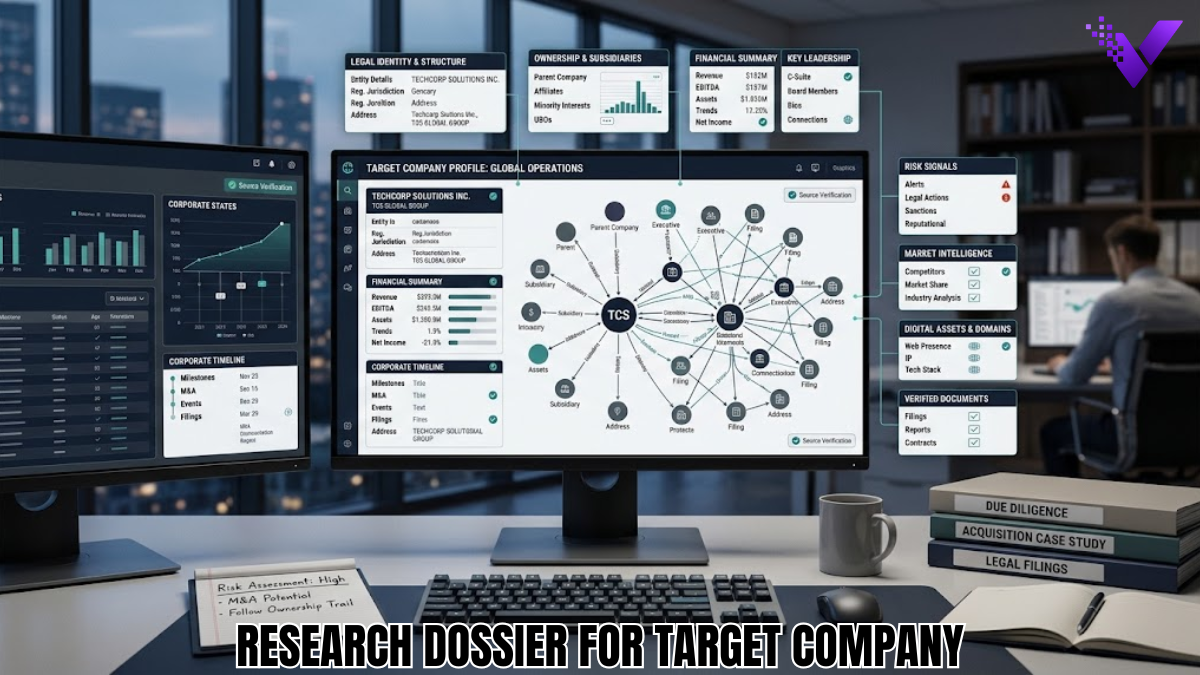
Search for direct parents, ultimate parents, operating subsidiaries, holding companies, sister entities, joint ventures, and historical ownership changes. Build the relationship as a simple graph rather than burying it inside paragraphs.
Where available, the Legal Entity Identifier system can provide standardized organizational identity information. GLEIF describes Level 1 data as answering “who is who”, while Level 2 relationship records can identify direct and ultimate accounting-consolidating parents.
Example structure:
Ultimate Parent
↓
Holding Company
↓
Target Entity
↙︎ ↓ ↘︎
Subsidiary A — Subsidiary B — Joint Venture
Ownership percentages should appear only when a credible record supports them.
Step 4: Establish Leadership and Governance
Separate current leadership from historical association.
Verify directors, officers, founders, board members, authorized representatives, and major executives using regulatory filings, corporate registries, company announcements, and reliable professional records.
For every person, capture:
| Attribute | Research Target |
| Current role | Exact official title |
| Appointment date | Start of documented involvement |
| Previous roles | Relevant corporate history |
| Related entities | Other board or ownership connections |
| Departure status | Active or former |
| Source date | Freshness of evidence |
Avoid assigning strategic responsibility to someone simply because an old biography still appears online.
Step 5: Examine Financial and Funding Evidence
Public and private companies require different treatment.
For listed businesses, work from annual reports, quarterly disclosures, debt filings, securities documents, investor presentations, and audited statements. SEC EDGAR, for example, supports company searches, full-text filing searches, structured XBRL information, and data APIs.
Private-company research may instead rely on statutory accounts, capital filings, disclosed funding rounds, secured-charge records, creditor notices, grant databases, and investor announcements.
Calculate trends only from compatible figures.
Do not place revenue estimates beside audited revenue without clearly labeling the difference.
Step 6: Map the Operating Business
Identify what actually produces commercial value.
Break the company into observable components:
- Products and services
- Customer types
- Countries served
- Distribution channels
- Pricing structure
- Strategic partnerships
- Physical facilities
- Key operating brands
Website copy can explain positioning, but it should not automatically be treated as evidence of market share, customer scale, profitability, or adoption.
Step 7: Build a Digital Asset Map
Corporate intelligence now includes infrastructure.
Record official domains, regional domains, customer portals, product subdomains, mobile applications, developer properties, support centers, and verified social accounts.
Domain-registration information can help with infrastructure research, but modern registration data may be privacy or proxy protected. ICANN explicitly notes that public WHOIS information can vary and may hide registrant personal information; it also provides a formal request route for certain nonpublic gTLD data.
Treat domain ownership as one evidence layer, not standalone proof of corporate ownership.
Step 8: Construct the Company Timeline
Chronology reveals patterns that individual records miss.
Create dated entries for:
- incorporation;
- major funding;
- acquisitions;
- divestitures;
- executive changes;
- market entries;
- product launches;
- regulatory actions;
- restructurings;
- major legal disputes;
- closures or insolvency events.
Each event needs a date, event type, evidence source, and relevance note.
A timeline can reveal whether management changes preceded restructuring, whether acquisitions created the present business model, or whether public claims align with documented history.
Step 9: Investigate External Risk Signals
Move beyond company-controlled information.
Search regulatory agencies, court databases, sanctions resources, credible journalism, product recalls, enforcement records, consumer-protection actions, and sector-specific watchdogs where relevant.
Classify findings by evidence strength:
| Classification | Meaning |
| Confirmed | Supported by authoritative documentation |
| Corroborated | Supported independently by several credible sources |
| Reported | Credible publication reports it, but primary record unavailable |
| Alleged | Claim exists without sufficient confirmation |
| Unresolved | Evidence conflicts or remains incomplete |
This vocabulary prevents accusations from being converted into facts through careless writing.
Step 10: Build the Evidence Register
Every material statement should have a provenance record.
A working evidence register can contain:
| Evidence ID | Claim | Source Type | Publication Date | Retrieved | Confidence |
| E-001 | Legal entity exists | Government registry | Current record | Research date | High |
| E-002 | Executive appointment | Official announcement | Event date | Research date | High |
| E-003 | Market expansion | Trade publication | Article date | Research date | Medium |
Store archived copies where legally appropriate. Pages disappear, URLs change, and company websites are frequently rewritten.
Step 11: Resolve Contradictions
Contradictions deserve their own research pass.
Suppose a company biography says it was founded in 2014, while the legal entity was incorporated in 2017. Neither record automatically invalidates the other; the business may have operated under an earlier structure.
Document:
Claim A → Source A → Claim B → Source B → Plausible explanation → Verification status
Do not silently select whichever version appears more convenient.
Step 12: Write the Decision Layer
Finish with analysis, not another data dump.
Separate the document into:
Verified facts → Material observations → Open questions → Decision implications
A useful research dossier for target company makes the boundary between evidence and analyst interpretation obvious. Readers should know when they are looking at a registry fact, a calculated observation, or a hypothesis needing more work.
Industry and Use-Case Specific Scenarios
M&A Screening
Acquisition teams can use the dossier to discover entity complexity, unusual ownership chains, historical restructuring, dependent subsidiaries, and inconsistencies between commercial narratives and corporate records.
The goal at the screening stage is not full legal due diligence. It is to identify areas that justify deeper specialist review before substantial resources are committed.
Enterprise Procurement
Procurement teams can examine corporate continuity, ownership transparency, geographic exposure, operational dependencies, certifications, and supplier concentration.
This becomes especially useful when the vendor will process sensitive information, provide infrastructure, or support a business-critical function.
B2B Sales Intelligence
Sales researchers can identify organizational changes, expansion activity, relevant executives, new business units, geographic growth, and strategic initiatives.
That context allows outreach to reference observable business conditions instead of relying on generic personalization.
Competitive Intelligence
A competitor file can track portfolio changes, hiring direction, acquisitions, geographic movements, partnerships, intellectual-property activity, and public positioning.
The emphasis is not merely “what the competitor sells.” The stronger question is where its resources appear to be moving.
Investigative Journalism
Journalists can connect legal entities, directors, historical names, corporate addresses, ownership relationships, archived statements, and documented transactions before approaching subjects for comment.
A well-maintained evidence trail also makes fact-checking faster during editorial review.
Investment Research
Investors can examine the relationship between management statements, regulatory disclosures, capital allocation, segment performance, corporate transactions, and changes in ownership.
The dossier becomes a research foundation rather than a substitute for valuation work.
Primary-Source Research vs Web-Summary Research
| Factor | Primary-Source Approach | Web-Summary Approach |
| Evidence origin | Registry, regulator, filing or issuer | Aggregated third-party pages |
| Entity precision | Identifier-driven | Usually name-driven |
| Historical depth | Often document-level | Commonly compressed |
| Ownership analysis | Can expose formal relationships | Frequently simplified |
| Update traceability | Filing or record date visible | Update timing may be unclear |
| Contradiction handling | Original records can be compared | Conflict may disappear in summarization |
| Citation durability | Strong when archived | Depends on publisher stability |
| Review suitability | Better for audit-sensitive work | Better for early discovery |
| Research speed | Slower initially | Faster initially |
| Main role | Verification | Lead generation |
The two approaches are not mutually exclusive. Search summaries are useful for finding leads, while authoritative records are better suited to confirming material claims.
Common Mistakes & Best Practices
Common Mistakes to Avoid
- Researching the brand instead of the entity. A commercial name may cover several separate corporations.
- Treating search-result snippets as evidence. Snippets can be truncated, stale, or detached from the page context.
- Mixing reporting periods. Comparing a calendar-year figure with a different fiscal period can create false trends.
- Using current executives to explain historical decisions. Leadership may have changed after the event.
- Assuming absence equals proof. Failure to locate a lawsuit, subsidiary, investor, or filing does not prove none exists.
- Copying database classifications without interpretation. Industry codes often fail to describe diversified companies accurately.
- Ignoring source incentives. Investor decks, vendor profiles, affiliate reviews, and company biographies are produced for different purposes.
- Converting correlation into causation. Two events occurring close together do not establish that one caused the other.
How to Maximize Efficiency / Best Practices
- Search identifiers early. Company numbers, CIKs, LEIs, security identifiers, and exact legal names reduce false matches.
- Use source-specific queries. Search regulatory databases directly instead of expecting general search engines to index every document.
- Keep an alias dictionary. Store old company names, abbreviations, acquired brands, transliterations, and local-language variations.
- Tag evidence by freshness. Fast-changing information deserves a shorter review interval than incorporation history.
- Capture negative searches. Record which authoritative databases were checked even when nothing material appeared.
- Separate collection from interpretation. Analysts make fewer premature assumptions when fact gathering happens before synthesis.
- Preserve document versions. A later corporate update should not erase the exact material used for an earlier decision.
- Assign confidence explicitly. High, medium, low, and unresolved labels expose weak areas immediately.
Future and Modern Trends in Company Research
Corporate research is moving toward structured, machine-readable evidence.
The SEC already provides APIs covering submission histories and financial-statement data, making large-scale filing analysis easier than manual document-by-document review.
Global entity resolution is becoming stronger as well. GLEIF’s public search infrastructure supports organization records, ownership relationships, mapped identifiers, and advanced filters; its database contained more than 3.4 million LEI search results in September 2026.
Knowledge graphs are another major shift. Instead of storing isolated facts, modern research systems can represent companies, directors, domains, subsidiaries, investors, locations, filings, and transactions as connected nodes.
AI will increasingly handle document classification, entity extraction, timeline generation, multilingual normalization, and anomaly detection. Human review remains necessary where identity matches are ambiguous, sources conflict, legal significance matters, or a model has inferred a relationship not explicitly documented.
Privacy rules are simultaneously reducing some forms of openly accessible identity information. Domain research illustrates the change: registrant details may be masked, making multi-source verification more valuable than older WHOIS-only investigation methods.
The strongest research dossier for target company will therefore become less like a static PDF and more like a versioned intelligence record with source lineage, structured relationships, confidence ratings, and controlled updates.
Practical Checklist
Before releasing a dossier, confirm that:
- Every document shows a research cut-off date.
- The legal entity has a unique identifier, not just a name match.
- Historical records are clearly separated from current records.
- Monetary figures show currency and reporting period.
- Estimates are visually distinguishable from reported numbers.
- Screenshots or saved records preserve material pages likely to change.
- Conflicting claims appear in a dedicated discrepancy log.
- Sensitive personal information has a legitimate research purpose.
- Each major conclusion links back to evidence.
- Unsupported allegations are excluded or explicitly characterized.
- Unknown information remains labeled unknown rather than guessed.
- The final reviewer can identify the author or research owner.
- Access permissions match the sensitivity of the material.
- A future review date exists for time-sensitive intelligence.
Final Thoughts
A research dossier for target company is valuable because it converts fragmented information into traceable corporate intelligence. Depth alone does not make the work reliable; identification accuracy, evidence provenance, chronology, and disciplined uncertainty matter more.
Build the file so another analyst can challenge it. When every major statement has a source, a date, and a defined confidence level, the dossier remains useful long after the first search session ends.
Frequently Asked Questions – FAQs
How long should a company research dossier be?
There is no fixed page count. A focused screening document may need 5–15 pages, while transaction, litigation, investment, or investigative research can extend far beyond that.
The correct length is the amount required to answer the defined research question without burying material information.
Is company dossier research legal?
Researching legitimately available corporate information is generally possible, but privacy, data-protection, database-access, contractual, and jurisdiction-specific rules can affect how information is collected or used.
Sensitive investigations should receive appropriate legal review rather than assuming that publicly visible data can be used for every purpose.
Can a private company be researched without financial statements?
Yes. Researchers can still examine corporate filings, directors, secured interests, funding disclosures, ownership information, facilities, hiring activity, contracts, products, partnerships, litigation records, and digital properties where those records are legitimately available.
The resulting file must clearly state where financial visibility is limited.
How often should a target-company dossier be updated?
The update cycle should follow the volatility of the subject. Stable corporate-history sections may remain useful for years, while leadership, ownership, financing, regulatory status, and active disputes can require much more frequent checking.
Major transactions should trigger an immediate refresh.
What is the difference between a company profile and a company dossier?
A company profile primarily describes the business. A dossier documents the business while also preserving evidence, relationships, contradictions, risk indicators, timelines, and research judgments.
That makes the dossier suitable for decisions requiring verification rather than simple background reading.
What sources should be trusted most?
No universal hierarchy fits every fact, but official registries, regulators, court records, audited disclosures, and original corporate filings usually carry greater evidentiary weight for claims within their scope.
Credible journalism and specialist databases become especially valuable when they add context, uncover leads, or connect primary records.
Can AI create a reliable company dossier automatically?
AI can accelerate search organization, extraction, translation, classification, comparison, and document review, but automated output should not be treated as evidence itself.
Material facts still need to resolve back to the underlying source, especially when names are ambiguous or the result could influence financial, legal, employment, or reputational decisions.