





Sodiceram: Complete Guide to Meaning, Verification, and Ceramic Context
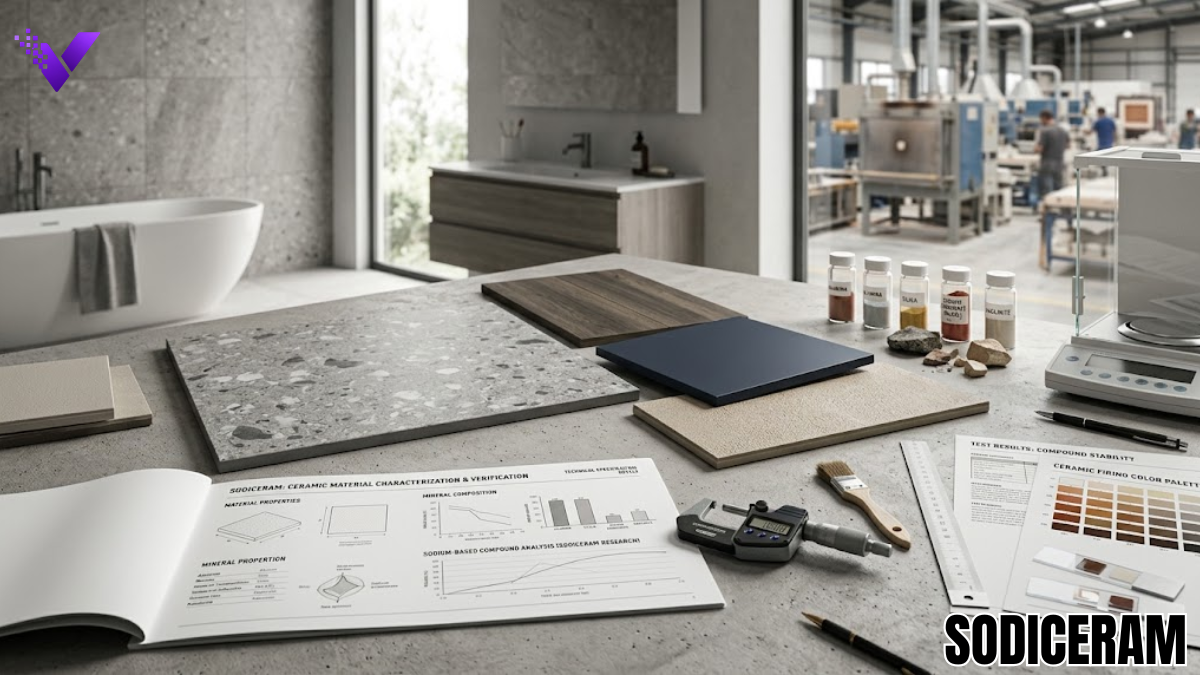
Sodiceram is a term with a real historical connection to the ceramics and bathroom-products trade, but its newer online meaning is less certain. French records document a company using the name in Reims, while recent articles increasingly describe the word as a sodium-related advanced ceramic concept.
That difference matters. A registered company, a technical material class, and an internet-created product label are three separate things.
For buyers, researchers, architects, publishers, and anyone checking unfamiliar building-material terminology, the safest approach is simple: verify the identity first, then evaluate the technical claims.
What Is Sodiceram?
Sodiceram does not currently have one universally established technical definition.
The clearest documented use relates to SO DI CERAM, a French limited-liability company associated with Reims. French corporate data records SIREN 315 383 091, an original creation date of January 1, 1979, and activities involving wholesale sanitary equipment and decorative products. The company was removed from the commercial register on October 11, 2023.
A French Court of Appeal decision also describes the business as operating in the sale and installation of tiles, sanitary products, and bathroom accessories.
Recent websites use the same word differently, often presenting it as an advanced ceramic associated with sodium compounds. That newer interpretation should be treated as an online concept unless a manufacturer supplies a formulation, datasheet, certification, patent, or recognized technical standard.
High-level verification flow:
Search term
→ Identify claimed entity
→ Check corporate or technical records
→ Locate product documentation
→ Compare claims with recognized ceramic science
→ Verify applicable standards
→ Decide whether the claim is supported
Why Is Sodiceram Important?
Understanding the term correctly protects readers from confusing documented history with unverified modern claims.
Key reasons include:
- Search accuracy: Similar articles can make an unsupported definition appear established through repetition.
- Procurement safety: Construction materials should be selected from measurable specifications, not a memorable name.
- Technical accuracy: Sodium compounds genuinely have uses in ceramic processing, but that fact alone does not establish a new material category.
- Historical research: The French business provides a traceable commercial context for the name.
- Specification control: Architects and contractors need data for absorption, strength, dimensions, chemical resistance, and intended installation conditions.
- Content credibility: Publishers can distinguish verifiable evidence from assumptions before repeating technical claims.
Quick Reference Matrix
| Core Element | Action / What it Involves | Primary Goal / Output |
| Identity | Match the name with records | Confirm what entity is being discussed |
| Business history | Check registry and court data | Establish commercial background |
| Material claim | Request composition documentation | Separate description from evidence |
| Testing | Review laboratory results | Measure actual performance |
| Classification | Compare with ceramic standards | Establish recognized product type |
| Supplier status | Confirm active legal entity | Reduce purchasing risk |
| Application | Match specifications to environment | Select suitable material |
| Traceability | Record model, batch, and producer | Support future verification |
Step-by-Step Deep Dive: How to Research Sodiceram Properly
Step 1: Determine What the Name Refers To
Start with the context in which the word appears.
A company listing, tile catalogue, technical paper, product label, architectural article, and social-media post carry very different evidentiary weight.
Use this sequence:
- Record the exact spelling.
- Identify the claimed manufacturer or organization.
- Note the country and address.
- Look for a registration number.
- Check whether a physical product code exists.
- Locate the original source behind the claim.
Do not assume that several websites repeating the same description represent independent confirmation.
Step 2: Verify the Historical Business Record
The French record provides unusually specific identifiers.
Pappers lists SO DI CERAM at 9 Route de Witry, 51100 Reims, with the legal form SARL and commercial activity centered on wholesale sanitary and decorative products. Its recorded additional activities included work involving tiling, painting, masonry, maintenance, and reinforced concrete.
The registry record also shows a former establishment closing date of September 30, 2021, followed later by removal from the registers in 2023.
These identifiers are far stronger evidence than an article merely describing a mysterious new ceramic.
Step 3: Separate Chemistry From Branding
Some newer explanations connect the term with sodium-containing ceramic formulations.
The underlying chemistry is plausible in a general sense. Sodium-bearing feldspars and other fluxing materials are established components in ceramic technology.
Research published in Resources, Conservation and Recycling explains that feldspathic fluxes are fundamental ingredients in many ceramic products, including wall tiles, floor tiles, sanitaryware, tableware, glazes, and coatings. Their function includes creating a liquid phase during firing that supports vitrification.
A 2024 review in Open Ceramics also reports that sodium oxide affects silicate structures and can contribute to fluxing behavior.
That supports sodium chemistry in ceramics.
It does not, by itself, prove that a standardized material category bearing this particular name exists.
Step 4: Request a Technical Datasheet
Any seller marketing a specialized ceramic should be able to provide measurable information.
Ask for:
- Product designation
- Manufacturer name
- Country of manufacture
- Body composition or material category
- Water-absorption classification
- Dimensions and tolerances
- Mechanical test data
- Chemical-resistance results
- Surface or glaze classification
- Applicable standard numbers
Marketing phrases such as high-performance, ultra-durable, or next-generation have little engineering value without test methods and numerical results.
Step 5: Check Recognized Tile Standards
For ordinary ceramic tiles, ISO 13006:2018 remains an important international reference for definitions, classification, characteristics, and marking. ISO states that the edition was reviewed and confirmed in 2024, although a replacement edition is now under development.
The related ISO 10545 series contains test procedures used for ceramic-tile characteristics.
For example, ISO 10545-13:2016 covers determination of chemical resistance at room temperature.
A credible specification should therefore identify the test rather than simply stating that a surface is “chemical resistant.”
Step 6: Match Performance to the Installation
A technically impressive material can still be wrong for the job.
Check requirements according to location:
| Installation | Data Worth Checking |
| Bathroom wall | Moisture exposure, cleaning compatibility, substrate |
| Kitchen floor | Wear, staining, maintenance, slip performance |
| Retail interior | Foot traffic, abrasion, replacement availability |
| Exterior wall | Weather exposure, attachment system, thermal movement |
| Industrial area | Chemical contact, load, impact, operating temperature |
The application should determine the specification.
The product name should not.
Industry and Use-Case Specific Scenarios
For Homeowners
A homeowner may discover an unfamiliar ceramic name while comparing bathroom or kitchen finishes.
The useful question is not whether the material sounds advanced. Ask instead for the manufacturer, exact collection, dimensions, finish, warranty terms, maintenance instructions, and replacement availability.
A sample should also be viewed under the actual room lighting before a large order is placed.
For Architects and Interior Designers
Design professionals need enough documentation to place a product into a specification schedule.
That normally means an identifiable supplier, product reference, intended installation method, technical declarations, finish information, and compatible fixing system.
A web article alone is not a specification document.
For Contractors
Installers face a different problem: compatibility.
Thickness, backing, dimensional consistency, adhesive selection, substrate preparation, joint width, movement accommodation, and cutting behavior can directly affect the finished installation.
Unknown materials should be trial-installed before being committed to a large site.
For Ceramic Researchers
Researchers encountering a claimed sodium-based material should search for its chemical formula, phase composition, processing route, firing curve, microscopy, X-ray diffraction data, porosity, density, and mechanical testing.
Without reproducible data, the name functions more like terminology than a scientific classification.
For Online Publishers
Search interest can grow faster than source quality.
Editors covering unfamiliar terms should create a source hierarchy: official records first, recognized standards second, peer-reviewed materials research third, manufacturers’ primary documentation fourth, and generic secondary articles last.
That approach prevents speculation from becoming circular evidence.
Documented Business vs Online Material Concept
| Comparison Factor | Documented French Business | Newer Material Concept |
| Traceable legal identity | Yes | No single identity established |
| Registered location | Reims, France | No universal origin |
| Historical commercial activity | Sanitary, decoration and tile-related trade | Described mainly in recent web content |
| Legal records | Available | Not applicable without identified producer |
| Standard formulation | Not a material formulation | No universally verified formula identified |
| Independent scientific definition | Not required for a company | Not established as a distinct category |
| Current status evidence | Registry shows removal in 2023 | Depends on individual claim |
| Best verification method | Corporate records | Datasheet, testing and technical literature |
Common Mistakes & Best Practices
Common Mistakes to Avoid
- Treating search-result volume as proof. Ten articles can originate from the same unsupported assumption.
- Assuming the name reveals the composition. A word that resembles “sodium” does not constitute chemical analysis.
- Buying from screenshots alone. Product photographs cannot establish density, absorption, strength, origin, or compliance.
- Confusing an old directory listing with an active supplier. Historical contact details can remain indexed years after a business changes status.
- Comparing materials without equivalent test methods. Two performance figures mean little when they were obtained through different procedures.
- Using generic ceramic claims for specialized environments. Laboratories, commercial kitchens, exterior façades, and residential bathrooms impose different requirements.
How to Maximize Efficiency / Best Practices
- Search registration identifiers, not just brand spelling.
- Save dated copies of specifications used for purchasing decisions.
- Ask suppliers for batch-level documentation on large commercial orders.
- Keep one physical control sample until the project is completed.
- Put performance requirements into the purchase order rather than relying on sales conversations.
- Confirm who carries responsibility for warranty claims before installation.
- Check whether matching replacements will remain available after the original order.
- Use an accredited materials laboratory when performance has contractual or safety consequences.
Future & Modern Trends
Searches for sodiceram illustrate a broader issue facing the construction and materials sectors: new terminology can spread online before a technical definition has been established.
The industry itself is moving in the opposite direction. Machine-readable product documentation, tighter traceability, standardized laboratory reporting, environmental declarations, digital building specifications, and batch-level manufacturing records are making vague product descriptions less useful.
Ceramic standards are evolving too. ISO currently lists a new edition of ISO 13006 as under development, while its ceramic-tile catalogue continues to expand the ISO 10545 test family.
Materials research is also pushing manufacturers toward alternative fluxes, recycled feedstocks, lower-energy firing strategies, and more efficient raw-material use. Those developments are scientifically meaningful because they can be evaluated through composition, processing conditions, and repeatable testing rather than branding alone.
Practical Checklist
Before relying on an unfamiliar ceramic name, confirm:
- The legal manufacturer or supplier can be identified.
- The product has a specific catalogue or model reference.
- A current technical datasheet is available.
- Packaging identifies the producer and production origin.
- Test reports name recognized methods.
- Values apply to the exact model being purchased.
- Installation instructions match the intended substrate.
- Cleaning restrictions have been reviewed.
- Warranty coverage is written rather than verbal.
- Samples match the ordered finish and calibre.
- Replacement stock can be sourced later.
- Claims from blogs have been checked against primary documentation.
Final Thoughts
Sodiceram is best approached as an ambiguous search term rather than automatically accepted as a newly established class of ceramic. There is strong evidence for a historical French business using the name, while the broader advanced-material definition circulating online lacks the same level of independent identification.
The practical rule is straightforward: trust specifications over terminology. A ceramic product proves its value through traceable manufacturing, appropriate classification, repeatable testing, and suitability for its intended environment.
Frequently Asked Questions – FAQs
Is Sodiceram a real company?
A French company called SO DI CERAM is documented in corporate and court records connected with Reims. Registry information shows that the business was removed from the relevant registers on October 11, 2023.
Is it officially recognized as a new ceramic material?
No authoritative source located for this guide establishes the name as a universally recognized scientific ceramic category. Individual sellers or publishers could still use it as a commercial or descriptive term, so any specific product must be assessed from its own documentation.
Does sodium have a legitimate role in ceramic manufacturing?
Yes. Sodium-bearing fluxes have established technical uses in ceramic processing, particularly where liquid-phase formation and vitrification are involved during firing. Peer-reviewed ceramic literature documents these mechanisms.
Can sodium content automatically make a ceramic stronger?
No. Final performance depends on complete formulation, particle characteristics, forming conditions, firing schedule, phase development, porosity, defects, glaze system, and intended test method.
A single ingredient cannot establish overall product quality.
How can I tell whether an unfamiliar ceramic product is genuine?
Request a manufacturer identity, catalogue number, technical datasheet, test reports, invoice details, physical address, warranty, and labelled sample.
Information that cannot be traced back to an accountable producer deserves additional verification.
What standard should I look for when researching ceramic tiles?
ISO 13006:2018 establishes definitions, classifications, characteristics, and marking requirements for qualifying ceramic tiles. The ISO 10545 series contains related test procedures for individual characteristics.
Can old Sodiceram contact information still appear online?
Yes. Search engines and directories can retain historical business pages after a company’s legal status changes.
Check the current registry record before treating an old address, telephone number, or directory listing as evidence that the original company still operates.