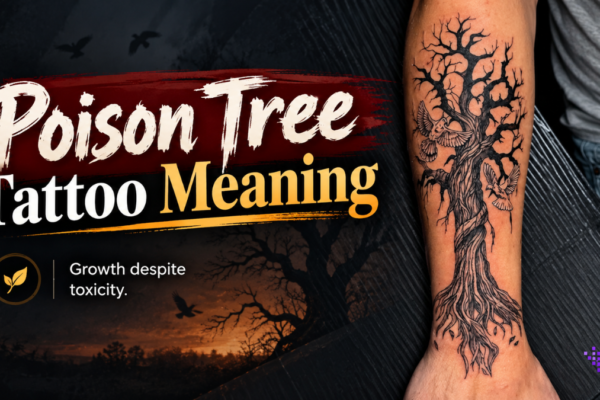






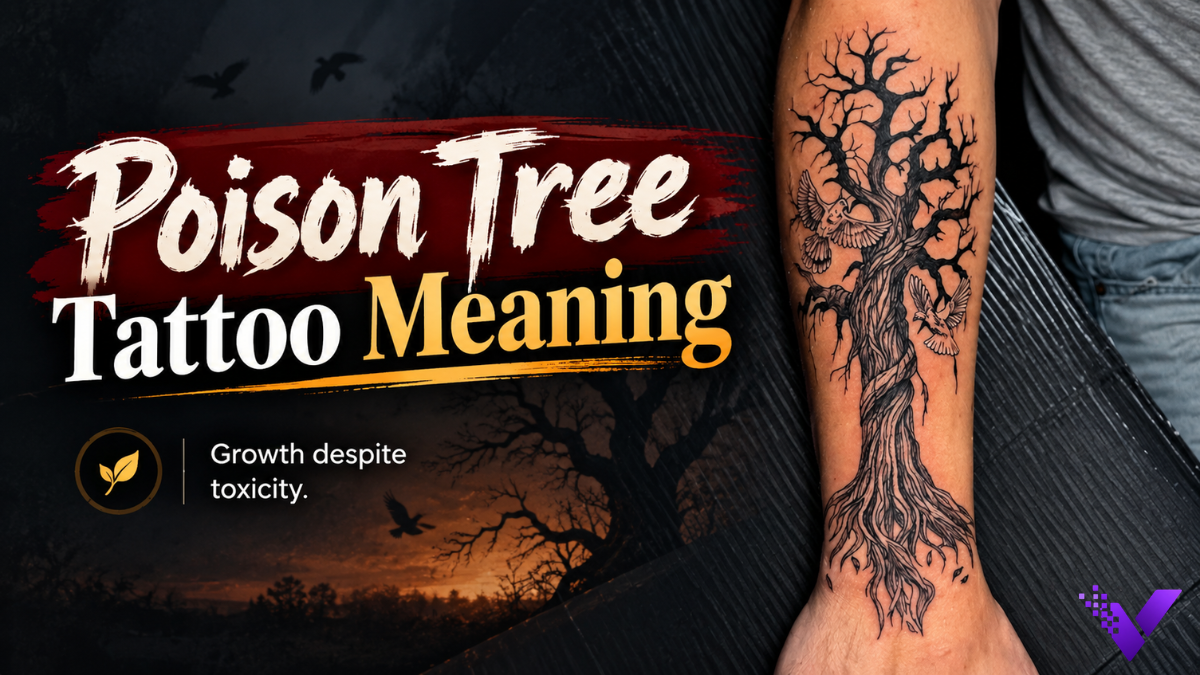
Poison Tree Tattoo Meaning: Complete Guide to Symbolism, Design Choices, and Personal Interpretation
A tree is usually associated with life, stability, family, and growth. A poisonous tree turns that familiar image into something darker. It can represent emotions or experiences that grew quietly until they became harmful.
The poison tree tattoo meaning is especially connected with suppressed anger, resentment, deception, temptation, emotional consequences, and personal awareness. A major literary influence comes from William Blake’s A Poison Tree, published in 1794, where hidden wrath grows metaphorically into a tree and eventually produces destructive results.
For tattoo wearers, however, the image does not have one fixed definition. The branches, fruit, roots, condition of the tree, surrounding objects, and personal story can completely change what the design communicates.
What Is the Poison Tree Tattoo Meaning?
The poison tree tattoo meaning centers on the idea that something apparently natural or beautiful can contain a dangerous inner history.
In Blake’s poem, anger expressed toward a friend disappears, while anger concealed from an enemy continues to grow. The speaker feeds that resentment through fear, tears, false smiles, and deception until the tree bears an attractive apple.
That gives the tattoo several possible layers:
Emotion → Suppression → Growth → Attraction or temptation → Consequence → Awareness
The tree therefore works less like a simple symbol of evil and more like a visual record of cause and effect.
A tattoo wearer might use it to mark an old grudge, a destructive relationship, a lesson about emotional control, or a period in life when something harmful was allowed to grow.
The Main Visual Symbols
| Symbol | Possible Interpretation | Visual Effect |
| Tree | A problem developing over time | Gives the design structure |
| Roots | Hidden origin or old history | Suggests depth |
| Apple | Temptation, consequence, attraction | Creates a focal point |
| Bare branches | Damage, loss, emotional exhaustion | Makes the piece darker |
| Healthy leaves | Danger hidden beneath beauty | Creates contrast |
| Thorns | Defense, hostility, painful boundaries | Adds aggression |
| Falling fruit | Consequences already unfolding | Adds movement |
| Broken trunk | Ending a destructive cycle | Signals interruption |
The apple deserves special attention. Blake explicitly includes a bright apple in the poem, but he does not directly identify it as the biblical fruit of Eden. Connecting the image with temptation or forbidden knowledge is therefore an interpretation rather than a literal statement from the text.
Why Is the Poison Tree Tattoo Meaning Important?
The poison tree tattoo meaning works well because the image can hold several emotional ideas without requiring explanatory text.
People may connect it with:
- Unspoken resentment — anger allowed to remain unresolved.
- Consequences — small emotional choices producing larger outcomes.
- Deception — outward calm hiding something hostile underneath.
- Temptation — something visually attractive carrying a harmful cost.
- Personal boundaries — recognizing people or environments that became damaging.
- Self-awareness — admitting that destructive emotions can also grow from within.
- Emotional maturity — remembering what happened when communication failed.
- Moral ambiguity — acknowledging that the victim and aggressor are not always visually obvious.
Its strength comes from contrast. A tree suggests growth. Poison suggests corruption. Putting both ideas together produces immediate tension.
Quick Reference Matrix
| Core Element | Action / What it Involves | Primary Goal / Output |
| Personal theme | Decide what the tree represents privately | Clear narrative |
| Tree condition | Select living, dying, twisted, or broken | Emotional tone |
| Fruit treatment | Feature, hide, damage, or remove the apple | Main symbolic focus |
| Root visibility | Expose or bury the root system | Show origin or mystery |
| Art style | Choose engraving, fine line, realism, blackwork, or illustrative | Visual identity |
| Composition | Build vertical, circular, or spreading structure | Body fit |
| Contrast | Separate dark tree forms from lighter skin space | Readability |
| Supporting object | Add only one meaningful secondary motif | Narrative depth |
How to Build a Poison Tree Tattoo Concept Step by Step
A strong poison tree tattoo meaning comes from designing backward from the idea rather than choosing an attractive tree first.
Step 1: Write the Meaning in One Sentence
Before discussing branches or shading, define what the tattoo should actually say.
Examples:
- “I no longer feed resentment.”
- “Beautiful things can still be dangerous.”
- “This marks the consequences of betrayal.”
- “I survived something that slowly became toxic.”
- “My darker emotions need recognition, not denial.”
Keep the sentence private if necessary. The artist does not need every personal detail, but they do need the emotional direction.
A vague instruction such as “make it dark” leaves too much unresolved.
Step 2: Choose the Life Stage of the Tree
The condition of the tree can communicate more than extra symbols.
Living tree
Dense foliage can suggest something harmful that still appears healthy from the outside.
Dead tree
A skeletal canopy produces a stronger association with aftermath, ending, or irreversible damage.
Half-living tree
One healthy side and one decayed side can represent internal conflict or gradual corruption.
Cut tree
A stump or severed trunk shifts attention toward interruption rather than continued growth.
Twisted tree
Distorted limbs create psychological tension without requiring skulls, snakes, or other obvious dark imagery.
The silhouette should remain recognizable even before small details are added.
Step 3: Decide What Happens to the Apple
Blake’s apple is one of the strongest literary identifiers in the entire concept. In the poem, the growing wrath eventually bears a bright apple that attracts the speaker’s enemy.
Different treatments create different readings:
| Apple Treatment | Design Direction |
| Single bright fruit | Makes temptation visually dominant |
| Rotten apple | Shows deterioration beneath the surface |
| Split fruit | Reveals hidden damage |
| Fruit on the ground | Suggests that an event has already occurred |
| Tiny distant apple | Keeps literary influence subtle |
| No fruit | Makes the design less Blake-specific |
| Several fruits | Turns one consequence into a repeated pattern |
Color is optional. A single red element inside an otherwise black-and-gray tattoo can pull the viewer’s eye directly toward the fruit.
Step 4: Use the Roots to Show History
Roots occupy a different symbolic role from branches.
Branches are visible. Roots are normally hidden.
Exposed roots can therefore represent:
- Old causes becoming visible
- Family or environmental influence
- A problem with a long history
- Something difficult to remove completely
Deep roots also work visually for long body areas such as the forearm, calf, thigh, ribs, or upper arm.
For compact placements, excessive root detail can become muddy once the tattoo ages. Strong shapes generally survive better than dozens of tiny crossing lines.
Step 5: Match the Style to the Story
The same subject can look philosophical, disturbing, historical, or contemporary depending on execution.
Engraving style
Crosshatching and etched lines create a look that feels compatible with older literature and printmaking. This is especially appropriate for a Blake-inspired piece because Blake himself worked as a poet, painter, and engraver.
Blackwork
Large dark shapes produce a heavier, more confrontational silhouette.
Fine line
Thin branches create a restrained appearance suited to people who want the symbolism without a large dramatic tattoo.
Illustrative
Allows unnatural branch movement, oversized fruit, geometric framing, or exaggerated roots.
Realism
Makes bark, leaves, fruit, and decay physically convincing. It can push the design away from literary symbolism and toward a naturalistic dark-art piece.
Step 6: Build the Composition Around the Body
Trees naturally spread outward, but skin provides limited space.
Use the body’s shape rather than forcing a square illustration onto it.
| Placement | Composition That Fits Naturally |
| Forearm | Narrow trunk with upward branches |
| Upper arm | Rounded canopy wrapping slightly sideways |
| Calf | Tall vertical tree with roots |
| Thigh | Larger scene with broad branching |
| Back | Full canopy and extended root system |
| Chest | Asymmetrical tree following the pectoral area |
| Ribs | Long curved trunk following the torso |
| Shoulder blade | Wide crown with moderate root detail |
Print the design at its intended physical size before tattooing. Tiny details that look impressive on a phone screen can become unreadable when reduced to a few inches.
Step 7: Remove Anything That Does Not Add Meaning
Dark tattoo concepts often become overloaded.
A tree does not automatically need:
- Ravens
- Snakes
- Skulls
- Clocks
- Eyes
- Flames
- Chains
- Multiple quotes
Each extra object competes for attention.
Ask one question: Would the tattoo lose an essential part of its story if this object disappeared?
If the answer is no, remove it.
Poison Tree Tattoo Use Cases
Different wearers can use the same core image for completely different reasons.
For Literature Readers
A reader of Blake can keep the piece close to the original poem through an engraved tree, solitary apple, restrained garden imagery, or a short text reference.
The literary connection works even without reproducing an entire verse.
For Someone Marking the End of a Toxic Relationship
A damaged tree can represent a relationship that developed gradually rather than failing suddenly.
Broken branches or severed roots can shift the focus toward separation without putting another person’s name, initials, or portrait permanently into the artwork.
For Personal Growth
The tree can function as a reminder that emotions require attention before they become patterns.
New leaves emerging from a damaged section can introduce a recovery theme without turning the original image into a simple positivity symbol.
For Gothic or Dark-Art Collectors
Some wearers may choose the subject mainly for its visual language.
Knotted bark, dead limbs, poisoned fruit, moonlit negative space, or an antique illustration style can create a strong gothic composition even when the tattoo is not autobiographical.
For Philosophy-Oriented Designs
The tree can represent cause and consequence rather than one specific emotion.
One action becomes a root. Repeated behavior forms the trunk. The eventual outcome appears as fruit.
That approach makes the design useful for ideas involving responsibility, temptation, secrecy, or moral choice.
Blake-Inspired vs Modern Symbolic Poison Tree Tattoos
| Factor | Blake-Inspired Design | Modern Symbolic Design |
| Source connection | Closely tied to the poem | Personal interpretation |
| Apple | Usually prominent | Completely optional |
| Visual era | Antique or engraved feel | Any contemporary style |
| Text | Poem reference may appear | Usually unnecessary |
| Creative freedom | Some source fidelity | Very high |
| Viewer understanding | Literary readers may recognize it | Meaning often remains private |
| Composition | Narrative illustration works well | Abstract layouts are possible |
| Longevity of idea | Connected to a specific literary work | Connected mainly to wearer experience |
Neither approach is automatically deeper.
The right one depends on whether the tattoo is meant to preserve Blake’s metaphor or create a new visual language from the same basic image.
Common Mistakes & Best Practices
Common Mistakes to Avoid
- Treating the symbolism as universal
Tattoo symbols rarely have one official definition. Personal context matters. - Using an inaccurate Blake quote
Online graphics often modernize punctuation or spelling. Check the actual poem before permanently tattooing text. - Making every branch equally detailed
Uniform complexity flattens the hierarchy. The eye needs obvious major branches before fine texture. - Ignoring negative space
Black lines packed too tightly can visually merge as the piece settles and ages. - Choosing placement after the drawing is finished
A wide tree created for paper may require major distortion when transferred to a narrow limb. - Using symbolism the wearer cannot explain to themselves
Other people do not need to understand the tattoo. The wearer should. - Adding dark imagery simply to make it look “deeper”
Visual complexity and conceptual depth are different things.
How to Maximize Efficiency / Best Practices
- Bring reference images by style, not copies to reproduce. Show the artist bark texture from one piece, branch structure from another, and shading preferences separately.
- Request a silhouette check. View the artwork from several feet away before approving intricate texture.
- Test orientation. Check how the tree reads when the arm or leg rests naturally.
- Limit tiny isolated highlights. They may dominate digital previews but contribute little from normal viewing distance.
- Photograph the stencil. A phone photo often reveals proportion problems that are harder to notice while looking directly at the body.
- Discuss future expansion. Leave usable space if a half-sleeve or larger connected piece may be added later.
- Let the tattoo artist simplify. Skin is not paper. Experienced artists often remove details specifically to make the final piece read better.
Future and Modern Tattoo Trends
The poison-tree concept is moving beyond the traditional dark tree with an obvious red apple.
Minimal narrative tattoos can show only a thin trunk, one branch, and one suspended fruit. The symbolism remains intact while the design occupies far less skin.
Woodcut and engraving-inspired work also fits the subject naturally. Fine parallel lines, controlled crosshatching, ornamental frames, and old-book composition connect literary material with tattoo craft without copying Blake’s original artwork directly.
Another direction uses selective color. Instead of coloring the entire tree, the artist can restrict pigment to one meaningful object such as the fruit, sap, flower, or newly growing leaf.
Digital sketching has also made body-specific planning easier. Artists can photograph the placement, overlay the composition, change scale, and test how branches interact with existing tattoos before the stencil stage.
Expect personalization to matter more than fixed symbolism. One tree can now carry literary, autobiographical, decorative, and philosophical layers simultaneously without looking like four separate tattoo ideas forced together.
Practical Poison Tree Tattoo Checklist
Before approving the final design, confirm:
- The central message can be stated in one sentence
- The chosen tree species or generic form fits the intended mood
- The overall silhouette remains readable at actual tattoo size
- Any written quotation has been verified against a reliable text
- The fruit has a deliberate visual role
- Empty skin has been intentionally preserved where needed
- Existing scars, moles, or nearby tattoos have been considered by the artist
- The design looks balanced while the body is in a normal resting position
- The artist’s portfolio contains comparable linework or shading
- The studio follows applicable local hygiene and licensing requirements
- You have received aftercare instructions directly from the professional doing the tattoo
- The concept still works even if a viewer never recognizes the literary reference
Final Thoughts
The strongest poison tree tattoo meaning is not simply “anger” or “toxicity.” The image is more useful as a symbol of development—how an emotion, relationship, deception, temptation, or unresolved experience changes when it is repeatedly fed.
Blake provides the literary foundation. Your own history determines the final reading. A well-designed version should still communicate visually even when nobody around you knows the poem.
Frequently Asked Questions – FAQs
Is the poison tree tattoo meaning always negative?
No. Its source imagery is dark, but the tattoo can mark awareness, closure, emotional discipline, or the ending of a harmful pattern.
The meaning depends heavily on what stage of the tree is shown and why the wearer chose it.
Does a poison tree tattoo have to reference William Blake?
No.
Blake’s poem is one of the clearest literary associations with the phrase, but a tattoo can use the image independently as a personal metaphor.
What does the apple represent in a poison tree tattoo?
The apple can represent temptation, attraction, consequence, deception, or the visible product of something hidden.
Blake includes a bright apple in his poem, where it becomes the object that draws the enemy toward the tree.
Can women and men use the same poison tree design?
Yes. The symbolism is not gender-specific.
Style, scale, placement, and personal interpretation determine how the piece feels far more than gender does.
Is a poison tree tattoo considered evil?
Not inherently.
A dark image can examine destructive behavior without celebrating it. Tattoos often portray uncomfortable subjects because they carry personal or philosophical significance.
Can I use a line from William Blake’s poem in the tattoo?
Yes. A Poison Tree is in the public domain, according to the Academy of American Poets.
For permanent lettering, verify the exact wording and decide whether you want Blake’s historical spelling and punctuation or a deliberately modernized version.
What tattoo styles work best for a small poison tree?
A simplified fine-line, blackwork, silhouette, or small engraving-inspired design usually adapts better than highly detailed realism.
At small sizes, emphasize the trunk, main branches, and one clear focal element rather than miniature bark and leaf texture.