





Serlig: Complete Guide to Its Meaning, Origin, and Modern Online Use
Serlig is one of those search terms that looks established before you examine it closely. Search results attach it to language, lifestyle ideas, digital publishing, branding, and online communities.
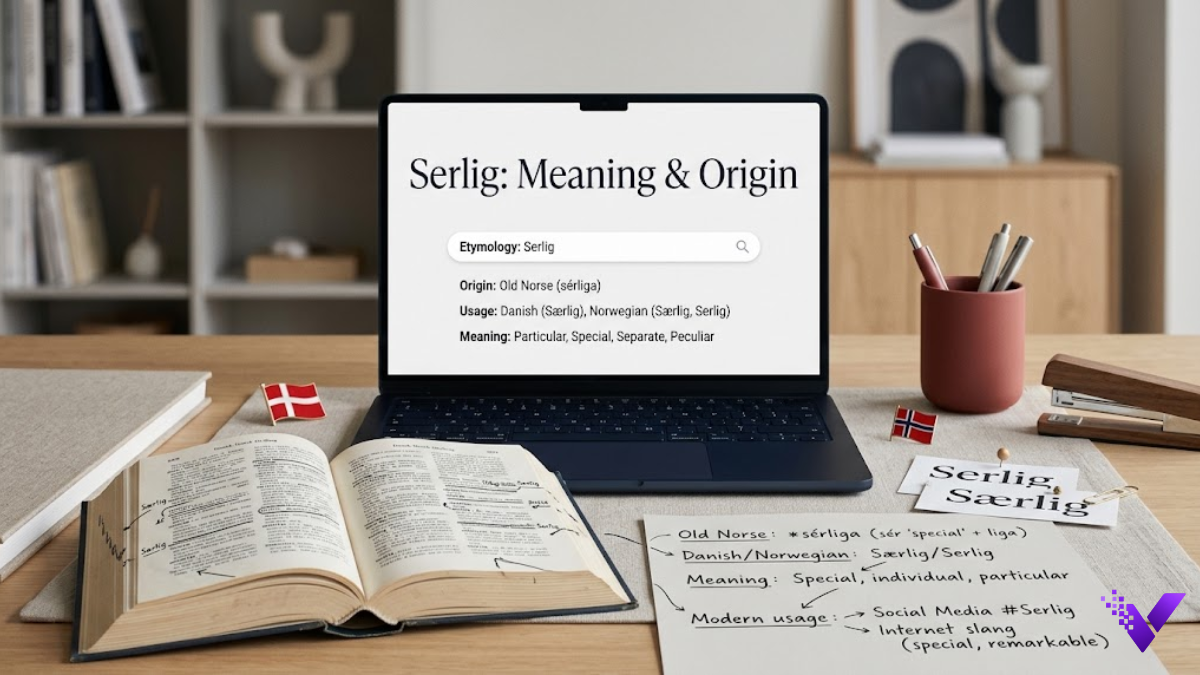
The evidence tells a more precise story. There is no single authoritative English definition for the spelling “serlig.” The clearest documented connection is the Scandinavian word særlig, while the simplified spelling has also been adopted independently by websites and content creators.
That distinction matters for readers, writers, researchers, translators, and publishers who need to know whether they are dealing with a real dictionary word, an altered spelling, or a brand-specific label.
What Is Serlig?
Serlig is best treated as a context-dependent spelling rather than a universally defined English term. In linguistic contexts, it is commonly associated with Danish and Norwegian særlig, meaning something like special, particular, specific, or especially, depending on grammatical use. In other contexts, “Serlig” may simply be a website name, brand, username, or coined expression.
Den Danske Ordbog traces særlig to Old Norse sérligr and defines it in part as something differing from what is usual. Norway’s Bokmålsordboka likewise traces the word to Old Norse and gives meanings including special and outside the ordinary.
Quick Meaning Flow
See the word → Identify the language or source → Check “særlig” → Check whether it is a proper name → Read surrounding context → Choose the correct interpretation
The process matters because identical-looking search queries can have completely different intentions.
Why Is Serlig Important?
The term matters less because it represents one major new idea and more because it illustrates several real problems in modern web research.
- Search ambiguity: A single spelling can surface linguistic definitions, websites, brands, and speculative explainers.
- Translation accuracy: Removing Scandinavian characters can obscure the original form of a word.
- Fact checking: Repeated claims across blogs do not automatically create an authoritative definition.
- Brand interpretation: A business may legally or informally assign its own meaning to an invented name.
- SEO research: Search-result volume can make a term appear established even when primary-source evidence is limited.
- Entity identification: Capitalization, URL context, and surrounding nouns can reveal whether the query refers to a name rather than vocabulary.
- Source quality: Dictionaries and language authorities carry more weight for linguistic claims than unsourced trend articles.
Norwegian language resources explicitly list særlig as the standard Bokmål spelling, while Nynorsk uses særleg.
Quick Reference Matrix
| Core Element | Action / What it Involves | Primary Goal / Output |
| Spelling | Compare serlig with særlig | Identify a possible simplified form |
| Language | Check Danish or Norwegian references | Establish linguistic context |
| Capitalization | Look for “Serlig” as a proper name | Detect brand or entity use |
| Source type | Separate dictionaries from blogs | Rank evidence quality |
| Surrounding text | Examine nearby words and topic | Determine intended meaning |
| Origin | Trace documented etymology | Avoid fabricated histories |
| Search intent | Identify what the searcher actually wants | Produce a relevant answer |
How to Interpret Serlig Step by Step
A reliable interpretation starts with evidence, not with whatever definition appears first in search results.
Step 1: Identify Where the Word Appears
Start with the original location.
Check whether the word occurs in:
- A Danish or Norwegian sentence
- A company or domain name
- A social-media profile
- An article headline
- A product label
- A search query
- A discussion where the writer may have omitted special characters
This first classification prevents a common research error: treating every occurrence as the same entity.
Step 2: Test the Scandinavian Connection
Replace the plain spelling with særlig and check whether the sentence still makes sense.
Official Danish and Norwegian dictionaries give a strong linguistic foundation. Danish særlig can describe something outside the usual or function adverbially to emphasize what a statement especially concerns. Norwegian Bokmål defines it as something outside the ordinary, distinct, or special.
| Context | Likely English Sense |
| Describing an unusual case | special |
| Referring to one defined subject | particular |
| Emphasizing one item | especially |
| Separating one case from others | specifically / separately |
The exact English translation should follow the sentence, not a one-word substitution.
Step 3: Check Whether It Is a Proper Name
Capitalized usage changes the investigation.
A page titled Serlig, for example, may use the term purely as branding. The website serlig.net currently presents itself as a general informational blog covering subjects such as technology, AI, apps, software, and other guides. That site identity does not establish a universal dictionary definition for its name.
Treat a brand name as an entity first.
Ask who operates it, what the site actually provides, when its claims were published, and whether independent sources confirm those claims.
Step 4: Separate Primary Evidence From Repeated Claims
Online repetition is weak evidence when the pages repeat one another without documenting the original source.
Recent search results show strikingly different descriptions. Some articles describe the term as a philosophy of authenticity or mindful living, while others frame it as a digital publishing or community concept. Other publications explicitly note that these explanations lack a consistent, independently documented origin.
A sound evidence hierarchy looks different:
| Evidence Level | Example | Research Value |
| Primary language authority | National or institutional dictionary | High |
| Official organization | Company or project’s own documentation | High for that entity |
| Independent reporting | Named publication with supporting sources | Contextual |
| General blog | Unsourced explainer | Limited |
| Copied summary | Recycled claims with no origin | Very low |
Step 5: Trace the Etymology Without Overreaching
The documented Scandinavian word has a clear historical trail.
Den Danske Ordbog identifies Old Norse sérligr as the origin of Danish særlig. Norway’s official Bokmål dictionary records the same Old Norse origin.
That evidence supports the history of særlig.
It does not automatically prove that every modern website using the plain-letter spelling deliberately derived its name from Old Norse.
Step 6: Match the Interpretation to Search Intent
A search query often provides more useful evidence than the isolated keyword.
Someone searching “serlig meaning” probably wants a definition. A query containing website, platform, login, or a domain name probably points toward a specific online property.
Use modifiers as classification signals.
| Query Pattern | Research Direction |
| “meaning” | Language |
| “Norwegian” | Bokmål usage |
| “Danish” | Danish vocabulary |
| “pronunciation” | Native-language reference |
| “website” | Entity research |
| “platform” | Product or service verification |
| “origin” | Etymology |
| “review” | Specific organization or service |
Step 7: Write Only What the Evidence Supports
Use precise wording when certainty is limited.
Good factual language includes phrases such as “appears to be associated with,” “the standard spelling is,” “this website uses the name,” or “no authoritative source located establishes that definition.”
Avoid turning speculation into fact.
That single editorial habit separates useful research from content written only to occupy a search-result position.
Industry and Use-Case Specific Scenarios
For Translators
A translator seeing the simplified spelling inside Scandinavian material should inspect the original alphabet and sentence structure.
Characters such as æ carry linguistic information. A plain-ASCII transcription may be convenient for usernames, URLs, or keyboards, but translation should normally return to the recognized source form before assigning meaning.
For SEO Editors
Unfamiliar trending keywords require entity verification before content production.
SERP volume alone cannot prove that a concept exists independently. Several sites can rank for the same unexplained query while deriving their definitions from similarly unsupported web content.
The editorial opportunity is therefore not to invent another meaning. It is to resolve the ambiguity better than existing pages.
For Brand Owners
A short, unusual name can be useful because it is memorable and visually compact.
The downside is semantic uncertainty. If an organization adopts such a name, its homepage, title tags, About page, structured data, social profiles, and press material should consistently explain what the organization actually does.
For Language Learners
Learners gain more from recognizing grammatical function than memorizing a rough translation.
In Danish, the documented word may act adjectivally or adverbially. That means its English rendering changes according to the surrounding construction rather than remaining fixed at “special.”
For Researchers and Journalists
The keyword provides a useful example of source contamination.
A claim can move from one low-authority webpage to several others and eventually look well established. Independent sourcing requires tracing the assertion backward until a dictionary, institution, identifiable organization, dataset, publication, or other primary record is found.
Established Linguistic Form vs Modern Online Usage
| Factor | Særlig: Linguistic Form | Serlig: Online Usage |
| Standardized spelling | Documented | Context-dependent |
| Dictionary support | Yes | No single universal entry established |
| Historical origin | Old Norse sérligr | Depends on individual use |
| Stable meaning | Relatively stable within grammar | Varies by source |
| Language context | Danish / Norwegian | International web |
| Capitalization | Ordinary word | Often used as a name |
| Verification method | Language authority | Entity-by-entity research |
| Interpretation risk | Low with context | Higher without context |
The Norwegian dictionaries are maintained by Språkrådet and the University of Bergen and explicitly identify the recognized Bokmål spelling and meaning.
Common Mistakes & Best Practices
Common Mistakes to Avoid
- Calling it an established English word without evidence. Search visibility is not dictionary recognition.
- Presenting one blog’s interpretation as universal. A private definition applies only as far as its creator establishes it.
- Ignoring the Scandinavian character æ. Letter substitution can erase the strongest clue about linguistic origin.
- Combining unrelated entities. A website, philosophy claim, username, and translated adjective may have nothing to do with one another.
- Using circular sourcing. Ten articles repeating the same unsupported statement still represent weak evidence.
- Inventing founders or launch dates. Entity facts require identifiable records.
- Assuming etymology proves modern branding intent. Similar spelling alone cannot establish why an organization chose a name.
How to Maximize Research Efficiency / Best Practices
- Search the exact spelling in quotation marks before broadening the query.
- Run a second search using the native Scandinavian spelling.
- Prioritize national dictionaries and language institutions for word-origin questions.
- Record publication dates when analyzing recent online interpretations.
- Separate lexical research from company research in your notes.
- Inspect the About, Contact, legal, and ownership pages when evaluating a branded entity.
- Look for independent references outside the original domain before accepting platform claims.
- Keep an evidence column beside every factual assertion while drafting.
- Use confidence language that matches the strength of the source.
Future & Modern Trends
Unfamiliar terms are likely to become harder to research as AI-assisted publishing, automated content production, domain branding, and rapid search-indexing produce large volumes of text around low-information queries.
A repeated phrase can develop an apparent digital history very quickly. Searchers may encounter dozens of pages before finding a primary source—or discover that no primary source exists.
Modern search systems are also moving toward entity understanding, not simple keyword matching. That favors pages that clearly distinguish a recognized linguistic entity from a company name, product, person, or invented concept.
Another shift involves machine translation and international keyboards. Special characters are frequently removed in URLs, usernames, filenames, and informal typing. Researchers therefore need to test diacritic variants before declaring an unfamiliar spelling to be a newly coined word.
The strongest future content will be source-aware. It will explain what can be verified, identify what remains ambiguous, and resist filling factual gaps with attractive but unsupported narratives.
Practical Verification Checklist
Use this before publishing material about an unfamiliar term:
- Exact-match search completed
- Native spelling variants checked
- Dictionary status confirmed
- Language of origin identified
- Proper-name possibility tested
- Domain ownership context reviewed where relevant
- Independent sources located
- Original source separated from copied articles
- Dates checked for recent claims
- Translation matches sentence context
- Claims without evidence removed
- Brand meaning kept separate from dictionary meaning
- Uncertainty stated where evidence remains incomplete
- No invented founder, platform feature, or history included
Final Thoughts
The safest way to understand serlig is to resist assigning it one dramatic universal definition. Strong linguistic evidence points toward Scandinavian “særlig,” while modern web uses must be evaluated separately according to their source.
That approach may sound less exciting than declaring a new philosophy or technology trend, but it produces something much more valuable: information readers can actually verify.
Frequently Asked Questions – FAQs
Is Serlig an English word?
It is not established by the authoritative Scandinavian sources reviewed as a standard English vocabulary item. Online pages use the spelling in several ways, so its meaning should be determined from context rather than assumed.
What does “særlig” mean in Norwegian?
Norway’s Bokmålsordboka describes særlig as something outside the ordinary and gives related senses such as special or distinct. It can also function adverbially in sentences.
What does “særlig” mean in Danish?
Den Danske Ordbog records senses involving something that deviates from what is usual and adverbial uses that emphasize a particular part of a statement. Depending on context, English translations may include special, particular, especially, or related terms.
Where does the Scandinavian word come from?
Both Danish and Norwegian dictionary sources trace it to Old Norse sérligr. That gives the established Scandinavian form a documented historical basis.
Is it the name of a digital platform?
The name appears online in connection with websites and articles discussing digital publishing, but that does not establish one universal platform represented by the word itself. For example, serlig.net currently describes itself broadly as an informational blog, while one of its pages separately presents a “Serlig-style” digital environment concept.
Why do websites give different definitions?
Different publishers appear to be interpreting or repurposing an ambiguous search term independently. Recent articles variously describe it as a lifestyle idea, communication concept, linguistic variant, brandable name, or digital-platform concept, which is precisely why source verification is necessary.
Should I write “serlig” or “særlig” in Norwegian?
For standard Norwegian Bokmål, the dictionary spelling is særlig. In Nynorsk, the corresponding recognized form is særleg.