




Caricatronchi: Complete Guide to Forestry Log Loading and Equipment Selection
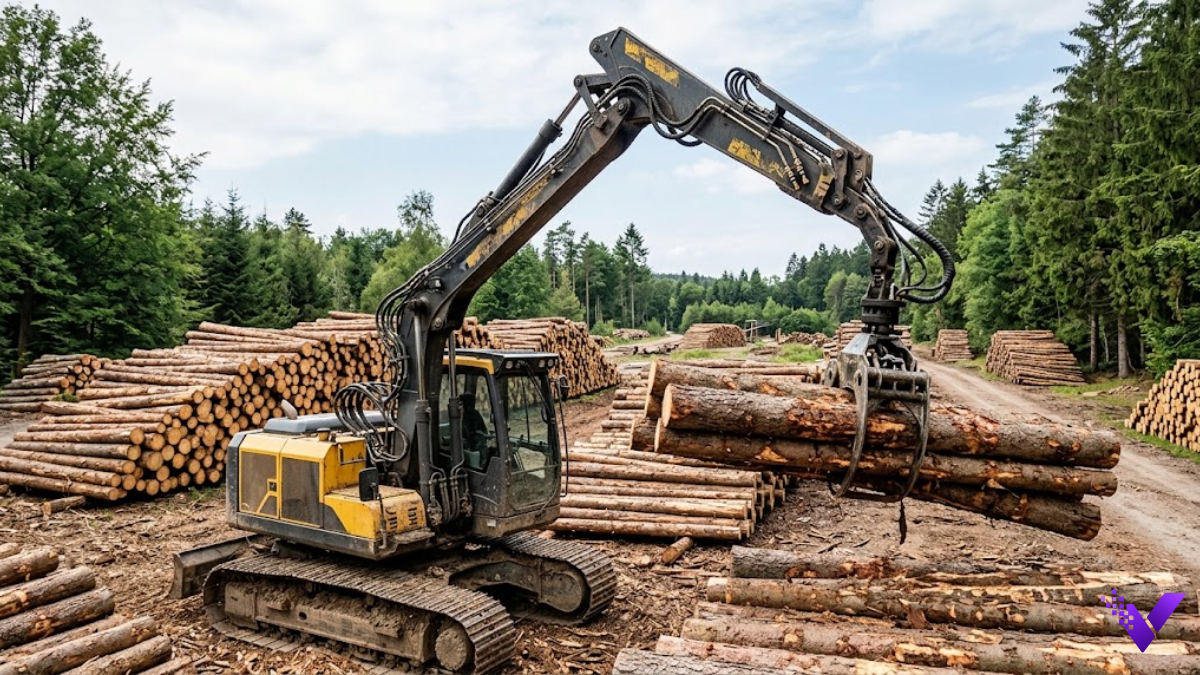
Caricatronchi refers to forestry equipment used to grip, lift, position, load, and move logs. The term appears in established Italian forestry and machinery contexts, including regional technical documents and equipment specifications.
The equipment ranges from hydraulic grapples fitted to excavators to tractor-mounted cranes, forestry trailers, sawmill loading systems, and purpose-built log handlers. The correct configuration depends on timber size, operating radius, terrain, carrier weight, and daily workload.
A second meaning has appeared on some recent websites, where the word is presented as a digital-art label. That interpretation is not established in traditional art terminology, while the forestry usage can be independently verified through machinery manufacturers and Italian forestry documentation.
What Is Caricatronchi?
In practical forestry language, caricatronchi is log-loading equipment. It may describe a complete loader or appear in phrases such as pinza caricatronchi, meaning a grapple designed to handle trunks and cut timber.
Italian regional forestry material explicitly refers to “pinza caricatronchi” and hydraulic cranes equipped with such grapples. Volvo also describes an L350H wheel loader in a dedicated log-handler configuration.
Basic operating flow
Felled timber → Grapple closes around logs → Hydraulic boom lifts load → Rotator aligns timber → Operator transfers load → Logs are stacked, loaded, or fed into processing equipment
The grapple provides the grip. The boom supplies reach. Hydraulic circuits create movement and clamping force. The carrier supplies stability, mobility, and power.
Why Is Caricatronchi Important?
Modern timber operations deal with heavy, irregular material that is difficult to move efficiently with general-purpose attachments.
Key operational benefits include:
- Controlled timber handling: purpose-designed arms hold cylindrical and uneven loads more securely than ordinary buckets.
- Reduced manual contact: workers spend less time physically positioning heavy logs near moving machinery.
- Better timber organization: individual trunks can be sorted by diameter, species, length, or destination.
- Higher equipment versatility: specialized grapples can be fitted to excavators, loaders, cranes, and other compatible carriers.
- Improved material placement: hydraulic rotation allows logs to be aligned before stacking or processing.
- Cleaner loading areas: controlled placement helps maintain organized landings, yards, and feed zones.
The UK Health and Safety Executive specifically identifies machine stability, terrain, operator understanding, tyres, outriggers, and suitable stacking areas as significant considerations when lifting timber in forestry.
Quick Reference Matrix
| Core Element | Action / What it Involves | Primary Goal / Output |
| Hydraulic boom | Extends and lifts | Creates working reach |
| Log grapple | Closes around timber | Maintains secure grip |
| Rotator | Turns suspended attachment | Controls log orientation |
| Carrier | Supports the lifting system | Provides mobility and stability |
| Hydraulic circuit | Supplies pressurized oil | Powers movement |
| Stabilizers | Increase support footprint | Reduces overturn risk |
| Guarding | Protects exposed areas | Limits damage in forest conditions |
| Controls | Direct boom and attachment | Gives operator precise movement |
How Caricatronchi Equipment Works: Step-by-Step Deep Dive
Step 1: Match the Carrier to the Job
Start with the machine carrying the attachment, not the grapple.
A lightweight mini excavator working with firewood has completely different requirements from a dedicated loader operating continuously in a timber yard.
Evaluate:
- Machine operating weight
- Permitted attachment mass
- Hydraulic pressure and flow
- Auxiliary hydraulic connections
- Counterweight configuration
- Undercarriage or tyre suitability
- Manufacturer attachment limits
Mounting an oversized grapple does not create a higher-capacity loader. It can instead reduce stability and usable lifting capacity.
Forestry attachments are commonly built for excavators, wheeled loaders, tracked carriers, and purpose-built machines, depending on their size and interface.
Step 2: Calculate Capacity at Working Reach
Maximum lift quoted near the crane column tells only part of the story.
Available lifting capacity falls as operating radius increases. The operator therefore needs the load chart or manufacturer data for the distance at which timber will actually be picked up.
Consider this example from BMF’s published specifications for its compact BMF430 forestry crane:
| Specification | Published figure |
| Maximum reach | 4.3 m |
| Lift at 4 m | 620 kg |
| Lift at full reach | 470 kg |
| Working pressure | 190 bar |
| Recommended pump flow | 30–60 L/min |
Those numbers apply specifically to that model, but they illustrate why reach and payload must be evaluated together.
Step 3: Select the Correct Grapple Geometry
Grapple size is not simply a question of choosing the widest opening.
Jaw geometry affects how the attachment handles single stems, bundles, short wood, branches, poles, and irregular material.
Check:
- Maximum jaw opening
- Minimum closed diameter
- Grapple weight
- Rated load
- Arm shape
- Pin and bushing construction
- Cylinder protection
- Load-holding provisions
Some forestry grapples use bypassing arms, allowing tighter control when handling individual poles or logs. Continuous rotators are also common in professional systems.
Step 4: Account for Attachment Weight
A crane’s available capacity is not entirely available for timber.
The grapple, rotator, coupler, hoses, boom extensions, and adapters all contribute dead weight. That mass must be carried before the first log leaves the ground.
A heavier attachment may offer greater durability while simultaneously reducing the amount of wood the machine can safely lift at long reach.
Use this calculation when comparing options:
Usable timber payload = permitted load at operating radius − attachment system weight
Never replace the manufacturer’s load chart with a rough calculation when determining actual machine limits.
Step 5: Verify Hydraulic Compatibility
Hydraulic mismatch can make an otherwise suitable attachment perform badly.
Check the carrier’s:
- Oil flow
- Operating pressure
- Return-line requirements
- Number of hydraulic functions
- Coupler type
- Hose diameter
- Cooling capacity
Insufficient flow produces sluggish cycles. Excessive flow may create heat or exceed component limits if the circuit is not correctly regulated.
The rotator also needs its own compatible hydraulic function if independent grapple rotation is required.
Step 6: Establish a Stable Loading Zone
Timber creates a constantly changing load center.
The machine should operate on firm ground with enough room for boom movement, carrier positioning, timber stacks, and transport vehicles.
The HSE recommends selecting equipment appropriate to the terrain, planning extraction routes to avoid lifting on side slopes, using stabilizing equipment where applicable, maintaining correct tyre pressure, and placing timber stacks on firm, level areas.
A few degrees of slope can matter when a heavy load is held well outside the carrier’s normal footprint.
Step 7: Control the Log Through the Full Cycle
Smooth movement matters more than raw speed.
A professional loading cycle normally requires:
- Approach the timber with the grapple open.
- Center the jaws around a stable section.
- Close until the load is positively secured.
- Lift only enough to confirm control.
- Bring the load into the safest practical boom geometry.
- Rotate it into the required orientation.
- Move toward the destination without abrupt swing.
- Lower into position before releasing the jaws.
Fast swinging with a suspended trunk generates dynamic forces that differ substantially from a stationary load.
Step 8: Inspect High-Wear Components
Forestry is abrasive.
Mud, bark, impact, vibration, wood debris, and repeated hydraulic cycles concentrate wear around a small number of components.
Inspect:
| Area | What to Look For |
| Grapple arms | Bending, cracking, uneven closure |
| Pins and bushes | Excessive movement |
| Hydraulic hoses | Abrasion, cuts, leakage |
| Cylinders | Damaged rods or seals |
| Rotator | Play, leaks, irregular rotation |
| Welds | Hairline cracking |
| Coupling points | Loose fasteners or distorted plates |
| Guards | Missing or damaged protection |
Maintenance frequency should follow the carrier and attachment manufacturers’ service schedules, particularly for lubrication and hydraulic inspection.
Industry and Use-Case Specific Scenarios
Small Woodland and Firewood Operations
Compact tractor or excavator setups suit operators moving shorter stems and processed firewood without maintaining a large dedicated loading machine.
The priority is usually low machine weight, straightforward maintenance, and compatibility with equipment already owned.
Commercial Forestry Landings
Professional harvesting sites need equipment capable of maintaining repetitive loading cycles while handling long stems and mixed timber sizes.
Reach, structural durability, visibility, machine guarding, and service access become more significant as annual operating hours rise.
Sawmill Log Yards
Sawmills need precise placement rather than forest extraction capability.
A loader may sort incoming timber, build decks, supply log-processing lines, or transfer material toward the sawmill. Wood-Mizer, for example, lists an inclined chain log loader as an option for its WM4000 industrial sawmill.
Biomass and Wood-Chipping Sites
Loose branches and irregular wood require different attachment behavior from straight sawlogs.
Equipment sellers offer forestry grapples for moving cut timber, branches, brush, and material supplied to chippers or biomass-processing systems.
Timber Transport
A forestry trailer with an integrated crane allows one system to perform loading, transport, and unloading.
This arrangement is particularly useful when a separate loader is unavailable at either end of the route.
Dedicated Log Loader vs Attachment-Based System
| Factor | Dedicated Forestry Loader | Attachment-Based Carrier |
| Main design purpose | Continuous timber handling | Multi-purpose machine use |
| Utilization model | Specialized | Flexible |
| Operator station | Optimized for loading | Depends on base carrier |
| Structural layout | Built around forestry duty | Limited by carrier architecture |
| Changeover | Rarely needed | Attachment can be removed |
| Fleet requirement | Adds another machine | Reuses existing asset |
| Maintenance structure | Forestry-specific components | Carrier plus attachment systems |
| Ideal environment | High-volume yards and logging | Mixed or seasonal work |
| Resale audience | Specialized buyers | Broader machine market |
Purpose-built loaders are not automatically the better economic choice. The answer depends on annual workload and how often the carrier must perform other jobs.
Common Mistakes & Best Practices
Common Mistakes to Avoid
- Buying by jaw width alone. Opening size says little about the carrier’s actual lifting ability.
- Ignoring rotator mass. Every kilogram hanging from the boom consumes part of the load allowance.
- Using construction assumptions in forestry. Timber swings, rolls, and shifts differently from soil or palletized goods.
- Judging capacity at minimum radius. Real loading frequently happens farther from the machine.
- Connecting unknown hydraulic components. Incorrect flow or pressure can damage seals, valves, and motors.
- Working across steep side slopes. Boom extension can move the combined center of gravity toward the tipping boundary.
- Buying used attachments without inspecting pins. Excessive joint wear reduces precision and can signal prolonged hard use.
How to Maximize Efficiency / Best Practices
- Stage timber by destination before trucks arrive.
- Keep common stem sizes within the operator’s easiest working arc.
- Specify protected hose routing where brush exposure is high.
- Stock frequently damaged fittings and hydraulic hoses on remote sites.
- Record recurring failures by operating hour instead of relying on memory.
- Choose grease points that technicians can reach without dismantling guards.
- Compare spare-part lead times before selecting an uncommon attachment brand.
- Use suitable lighting and camera systems when loading visibility is restricted.
- Train multiple operators on the same control layout to reduce dependence on one person.
Future and Modern Trends
Forestry loaders are moving toward more controlled hydraulics, modular attachments, better operator interfaces, and easier servicing rather than simply increasing machine size.
Manufacturers already market continuous-rotation grapples, protected hose layouts, high rotator torque, faster arm movement, and service-oriented designs. Barko, for example, lists 360-degree continuous rotation, simplified hose routing, hardened pins, and cushioned cylinders among current grapple features.
Safety systems are becoming more integrated with crane control. Hiab describes smart technologies intended to improve operator control and reduce unsafe machine operation in forestry and logging applications.
Purpose-built carriers remain another clear direction. Tigercat’s forestry loaders use machine structures designed specifically for forest duty rather than relying solely on converted general-purpose excavators.
Attachment modularity is developing at the same time. One carrier can potentially switch between log grapples, branch grabs, processing tools, forks, or other forestry implements, improving utilization for contractors handling varied work.
Practical Checklist
Before purchasing, renting, or commissioning a log-loading setup, confirm:
- The machine serial number matches available documentation.
- A readable load chart is available.
- Attachment weight is documented.
- Hydraulic couplings match the carrier.
- Replacement seals and pins can be sourced locally.
- Hose routing is protected from timber contact.
- The rotator has no abnormal free play.
- Structural welds show no unexplained repairs.
- Controls can be operated without awkward visibility restrictions.
- Transport dimensions fit the intended trailer or road movement plan.
- Tyre or track specification suits the working surface.
- Emergency procedures are understood by operators.
- Inspection responsibilities are assigned.
- Warranty exclusions have been reviewed.
- Local machinery and lifting rules have been checked before operation.
Final Thoughts
A caricatronchi setup is best understood as an engineered timber-handling system rather than just a large hydraulic grab. Performance comes from the relationship between carrier stability, boom geometry, hydraulic capacity, grapple design, and the actual timber being handled.
The smartest purchase is rarely the attachment with the biggest opening or highest headline rating. Match the entire machine to the heaviest realistic load, longest normal reach, terrain, annual operating hours, and available maintenance support.
Frequently Asked Questions – FAQs
What does caricatronchi mean in English?
The closest practical English terms are log loader, timber loader, log-handling equipment, or log-loading grapple, depending on what part of the machinery is being described.
Official Italian forestry material uses related terminology for grapples and hydraulic crane systems used to handle timber.
Is a forestry loader the same as a forwarder?
No. A forwarder transports timber off the ground on its own load space, while a loader’s primary role is material handling.
A forwarder normally includes its own crane, so one machine may perform both functions.
Can a log grapple be installed on an excavator?
Yes, provided the attachment weight, coupling arrangement, hydraulic requirements, and operating limits are compatible with that excavator.
Commercial forestry grapples are sold for excavators and mini excavators across multiple machine-weight classes.
What is a pinza caricatronchi?
Pinza means grapple or grab in this equipment context. The phrase therefore identifies the gripping attachment rather than necessarily describing the complete crane or carrier.
One commercially listed Italian example has a 105 cm opening and 500 kg stated maximum load, illustrating how individual models can differ substantially in size and rating.
Is the term also connected with digital art?
Some recent websites use it as a label for exaggerated cartoon or caricature-style artwork. That usage should be treated as a newer online interpretation, not as a historically established artistic movement.
The forestry meaning has direct support from Italian public documents and machinery manufacturers.
What should I check when buying a used forestry grapple?
Look closely at weld repairs, bent arms, cylinder leakage, pin wear, rotator condition, hydraulic fittings, identification plates, and parts availability.
A low purchase price can quickly lose its advantage when a proprietary rotator or structural component requires replacement.
Can one loader safely handle every size of log?
No. Actual lifting ability depends on load mass, boom position, radius, carrier stability, attachment weight, and manufacturer limits.
The safe capacity at maximum extension can be considerably lower than the machine’s close-in lifting figure.